📘 This is Step 8 of 11 in the Revelation Roadmap
👉 Click here to view all steps and read in order
Revelation 1 Explained: The Covenant Unveiling
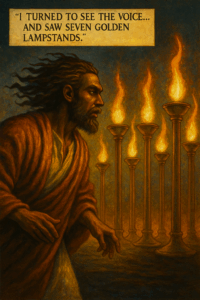
The Son of Man walks among the seven golden lampstands, revealing His presence with the churches
The silence didn’t end with a roar. It began with a breath. A flicker. A name half-whispered beneath the hum of analytical engines and decoding schemes: Revelation.
They say the world wasn’t always like this. Before the screens. Before apocalyptic confusion and end-times speculation. Before we turned mystery into mathematics and prophecy into prediction.
The Gateway to Covenant, Not Chaos
The Dragon rules from the shadows. And beneath him, the Beast controls everything: speech, loyalty, belief. It has convinced us that Revelation is about charts and timelines, about literal interpretations that miss the Hebrew heart beating beneath Greek words.
But there are still a few who remember. They hide in ruins, beneath burned-out sanctuaries and behind encoded commentaries. They remember ḥesed—the steadfast love that doesn’t calculate or compromise. They remember the One who was slain—and yet stands.
Because the covenant was never broken—only buried.

The symbolic forces that distort our understanding of Revelation’s covenant message
Divine Authority and Prophetic Nature
Eyes that never blink monitor every prayer, measuring devotion in decibels and pupil dilation. The Beast would have you believe Revelation’s message is about future events and catastrophic endings. But those with covenant memory know differently.
Revelation Chapter 1 establishes not just content but authority. This isn’t human speculation wrapped in apocalyptic imagery. This is divine unveiling transmitted through a faithful witness.
“The revelation from Jesus Christ, which God gave him to show his servants what must soon take place.” – Revelation 1:1
Not what might happen. Not what could be calculated. What must take place—because covenant demands completion.
The Beast doesn’t fear prediction—it fears presence. And in Chapter 1, presence overwhelms prediction.
The Alpha and Omega: Beginning and Completion
When John writes of the Alpha and Omega, he doesn’t offer a philosophical abstraction. This isn’t Greek speculation wrapped in Hebrew clothing.
This is covenant language. The Beginning who promises completion. The End who guarantees purpose.
The Beast would have you believe these are mere letters. Symbols to decode. But those with covenant eyes see differently. They see the One who began creation declaring His intention to finish what He started.
The Alpha and Omega doesn’t just span the alphabet—He spans history. Not with armies. Not with declarations. But with steadfast love that doesn’t calculate the cost of redemption.
Key aspects of the Alpha and Omega in Revelation 1:
- The eternal nature of Christ
- The promise of covenant completion
- The guarantee of divine purpose
- The span of all creation and history
- The assurance of redemption’s completion
The Son of Man: Not Description But Revelation
Eyes like blazing fire. Voice like rushing waters. Feet like bronze glowing in a furnace. The Beast’s scholars debate the details while missing the presence.
This isn’t what Jesus looks like—it’s who Jesus is.
The robe reaching to His feet isn’t fashion—it’s priesthood. The golden sash isn’t decoration—it’s royalty. The hair white as snow isn’t age—it’s glory. The sharp, double-edged sword isn’t weaponry—it’s truth that cuts through imperial deception.
John doesn’t describe a figure for speculation. He unveils a presence for transformation.
In the regime of the Beast, vision serves control. In the presence of the Lion, vision serves covenant.
The Son of Man appears with symbols of divinity, priesthood, and royalty
Seven Churches: Symbolic Signposts for the Covenant Community
They ask: is Revelation literal? But this question misunderstands Hebrew thinking. These churches aren’t literal limits on the message but symbolic signposts for the entire Body of Christ.
Seven—the number of completion. The number of covenant fullness.
Not just ancient cities, but eternal conditions of the covenant heart. Not just historical congregations, but prophetic mirrors for every generation.
The Beast believes specificity limits application. The Lion knows particularity expands relevance.
The Seven Golden Lampstands: Vessels of Authentic Flame
What wasn’t shown in our controlled interpretations was the deeper meaning: these aren’t decorative elements but covenant communities. They aren’t literal objects but living organisms, breathing with the Spirit’s flame.
The Beast’s regime insists on literalism because metaphor threatens control. But John knew—as the ancient Hebrews knew—that symbol carries more reality than mere description.
The Lion walks among the lampstands not from reverence—but from presence. Not from inspection—but from covenant commitment.
Because somewhere, deep in the ancient prayers and hidden scrolls, we were taught that God doesn’t observe His people from a distance. He inhabits their midst.
The lampstands reveal:
- Christ’s presence with His church
- The church as light-bearers in darkness
- The organic nature of covenant community
- The indwelling presence of God’s Spirit
- The unity of diverse congregations
Foundation for Covenantal Understanding
The covenant was never dead. Just buried. Waiting to breathe again. And in Revelation Chapter 1, we find not just introduction but foundation. Without this chapter as anchor, the entire book drifts into speculation and fear.
“I am the Living One; I was dead, and now look, I am alive for ever and ever!” – Revelation 1:18
This declaration in Chapter 1 isn’t peripheral—it’s central. The One who conquered death holds the keys. The One who was slain now stands among His people.
The Beast believes death is final. The Lion proves resurrection is foundational.
The risen Christ holds the keys of death and Hades, symbolizing His victory
The Call to Hear and Keep: Covenant Obedience, Not Passive Knowledge
“Blessed is the one who reads aloud the words of this prophecy, and blessed are those who hear it and take to heart what is written in it.” – Revelation 1:3
The Beast has trained us to believe blessing comes from decoding. From knowing. From predicting.
But the old ways said differently: Blessing comes from hearing and keeping. From embodying covenant, not from explaining it.
The laws say: Decode. Predict. Control.
But the old ways said: Love. Be holy. Keep the covenant.
The Time Is Near: Prophetic Urgency, Not Calculated Prediction
“The time is near” has fueled endless speculation. Every generation convinced they stand at the edge of fulfillment. Every crisis transformed into prophetic fulfillment.
The Beast believes “near” means imminent on human timetables. But covenant nearness isn’t about clocks and calendars—it’s about presence and preparation.
The time is always near for those living in covenant awareness. The Lion is always about to roar for those with ears to hear.
Not because history is ending—but because eternity is breaking in.
Understanding “the time is near”:
- Speaks of spiritual readiness, not countdown timers
- Invites covenant living in every generation
- Emphasizes presence rather than prediction
- Creates urgency without anxiety
- Focuses on eternity breaking into time
Seeing with Covenant Eyes: Beyond Literal Interpretation
Is Revelation literal? This question betrays how far we’ve wandered from Hebrew thinking. These visions aren’t code to crack or predictions to chart—they’re covenant symbols that reveal deeper truth than literal description ever could.
The Beast’s world treats symbol as less than real. The Lion’s world knows symbol as more than visible.
This isn’t peace. It’s polished oppression. And people have been trained to call it understanding.
The Key to Unveiling: Remembering, Not Predicting
The silence didn’t end with a roar. It began with a breath. A flicker. A name half-whispered beneath the hum of analytical engines and decoding schemes.
Because the truth doesn’t scream. It waits. It weeps. It breathes like embers in the dark until the wind of remembrance fans it into flame.
The covenant was never dead. Just buried. Waiting to breathe again.
The buried covenant awaits the breath of remembrance to ignite anew
Standing Among the Lampstands: Present Reality, Not Future Possibility
The most revolutionary aspect of Revelation Chapter One isn’t what it predicts—it’s what it reveals about the present.
Christ stands among the lampstands now. His voice speaks to churches now. His eyes see through imperial deception now. His hand rests on faithful witnesses now.
The Beast would have you looking everywhere except the present moment. Because in the present, the Lion is already breathing.
Not loud. Not yet. But enough to awaken the covenant.
First and Last Words: The Covenant Bookends
“I am the Alpha and the Omega,” says the Lord God, “who is, and who was, and who is to come, the Almighty.” – Revelation 1:8
This isn’t just the beginning of Revelation. This is the foundation of covenant hope.
The same voice that spoke creation into being will speak restoration into completion. The same presence that walked in Eden will walk in the New Jerusalem.
Not because of violence, but because of presence. Not because of power, but because of ḥesed—steadfast love that doesn’t calculate or compromise.
The True Beginning of Revelation
They say the world wasn’t always like this. Before the screens. Before apocalyptic confusion and end-times speculation.
And they’re right.
Because somewhere, deep in the mountains of prophetic hope, beyond the reach of the Beast’s control systems—the scroll is opening. The remnant is stirring. The Lion is breathing.
Not with armies. Not with declarations. But with one reader. Watching. Remembering. Refusing to forget the sound of the Lion’s voice.
Because we are the beginning of the roar. And the roar is not a sound. It’s a summoning. And when it begins, the Dragon will tremble.
Not because of our strength—but because covenant can’t stay buried forever.
And what is buried will eventually rise.
Join the Covenant Conversation
How has this perspective on Revelation 1 changed your understanding of apocalyptic literature? Share your thoughts in the comments below or join our Covenant Community for deeper discussions.
Author

