📘 This is Step 4 of 11 in the Revelation Roadmap
👉 Click here to view all steps and read in order
Unveiling Deception: How Truth Exposes Deception
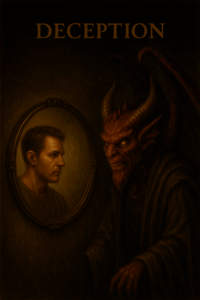
The Book of Revelation serves as a mirror, revealing what lies beneath our carefully constructed illusions
The Misunderstood Apocalypse
Revelation is often read as a prophetic timeline—a cosmic schedule of disasters meant to frighten humanity into compliance. But maybe that’s too shallow.
Maybe it’s better understood as the inevitable unraveling that happens when human beings construct elaborate systems of self-deception—a deception that spreads outward like ripples in still water, distorting everything it touches.
The apocalyptic literature isn’t primarily about the end of the world. It’s about the end of illusions. When John speaks of beasts rising from the sea and false prophets performing signs, he’s not giving us a preview of history’s final act—he’s exposing the machinery of deception that’s been operating since Eden.
And here’s the crux: deception always begins with a willing participant. Before we can be deceived by powers and principalities, we must first become accomplices in our own delusion. We must first refuse to see ourselves clearly.
This perspective fundamentally reorients how we approach the Book of Revelation. Rather than a text that transports us to a distant future, it becomes a mirror that reflects our present reality—often in ways we’d rather avoid seeing.
Deception’s First Home: The Self
Self-deception isn’t just a personal failing—it’s a gravitational force that pulls us away from truth, from wholeness, from God. To resist truth is to resist the very thing that gives us life, purpose, identity, and wholeness.
The human capacity for self-deception runs deeper than we typically acknowledge. We construct narratives that position us as heroes, victims, or martyrs—whatever serves to protect our fragile egos from uncomfortable truths. We embrace half-truths that flatter our sensibilities while avoiding the whole truth that might challenge them.
This pattern appears throughout scripture, not just in Revelation:
- Adam and Eve hiding in the garden, clothing themselves with fig leaves and excuses
- David convincing himself his desire for Bathsheba was justified
- The Pharisees believing their religious performance made them righteous
- Peter assuring himself he would never deny Jesus
Our deceptions promise protection but deliver isolation. They offer control but produce chaos. They whisper security but breed anxiety.
Revelation confronts these patterns not with gentle suggestion but with vivid, unsettling imagery. The text refuses to let us maintain comfortable illusions about ourselves or our world. It pushes us toward clarity—even when clarity burns.
The 7 Churches and Their Self-Deceptions
The churches in Revelation weren’t primarily threatened by external persecution—they were endangered by their internal compromises, their lukewarm commitments, their willingness to accommodate comfortable lies. Their greatest danger wasn’t the beast outside their walls but the blindness within their hearts.
When we examine Christ’s messages to the seven churches, we find a catalog of self-deceptions:
- Ephesus had convinced themselves that doctrinal precision could compensate for diminished love
- Pergamum believed they could simultaneously pledge allegiance to Christ and accommodate worldly values
- Thyatira told themselves that theological tolerance was more important than moral boundaries
- Sardis maintained a reputation for vitality while being spiritually dead
- Laodicea confused material prosperity with spiritual health
Each church received a specific diagnosis of their self-deception—not to condemn them, but to heal them. Not to reject them, but to restore them. The letters to the seven churches aren’t primarily warnings of future judgment but invitations to present clarity.
The same patterns play out in our communities today. Churches still convince themselves that correct doctrine compensates for diminished love. Religious institutions still mistake material prosperity for divine blessing. Communities of faith still accommodate cultural values that undermine their witness.
Beyond Timeline Theology: Revelation’s Deeper Purpose
The dispensationalist reading of Revelation—with its charts and timelines and escape hatches—isn’t just misguided exegesis. It’s a sophisticated form of spiritual avoidance. It transforms a call to faithful witness into a cosmic spectator sport. It allows us to obsess over decoding symbols while avoiding the harder work of confronting our own deceptions.
This approach treats Revelation as a puzzle to solve rather than a mirror to gaze into. It positions readers as detached observers rather than implicated participants. It transforms a text meant to expose our illusions into one that can actually reinforce them.
Biblical scholar Craig Koester notes that apocalyptic literature emerged not to satisfy curiosity about the future but to help communities navigate present crises with faithfulness and hope. Revelation wasn’t written to help believers escape the world but to help them engage it with clarity and courage.
When we reduce Revelation to a cosmic timeline, we miss its more immediate purpose: to unmask the deceptive systems—political, economic, religious—that promise security and prosperity while demanding our allegiance. John’s vision exposes how these systems operate and offers an alternative vision of allegiance to the Lamb who was slain.
Beasts Rising: Recognizing Modern Deceptions
The beast and false prophet aren’t just future figures—they’re present realities, archetypes of how power and religion can become vehicles of deception when divorced from truth and love. They succeed only where self-deception has already prepared the ground.
Throughout history, political and religious systems have demanded allegiance through a combination of intimidation and seduction. They promise security, prosperity, and meaning. They punish those who refuse to conform. They seduce through spectacle and reward compliance with comfort.
These systems thrive where people have already embraced certain deceptions:
- That security comes through control rather than surrender
- That prosperity equals blessing
- That comfort indicates rightness
- That power confers moral authority
Revelation unmasks these deceptions not just in ancient Rome but in every age—including our own. The imagery of beasts rising from sea and earth speaks to how these deceptive systems emerge from both chaotic disruption (the sea) and established order (the earth).
Today’s deceptions may not involve literal beast worship, but they still demand allegiance to systems that promise prosperity and security while delivering neither. They still mark participants—not with physical marks, but with patterns of thought and behavior that reflect their values.
The Most Insidious System: Self-Allegiance
But maybe we’re still missing something essential. Maybe beneath these external systems lies an even more fundamental deception—the system of self-allegiance.
Self-allegiance isn’t just selfishness. It’s a sophisticated internal framework that positions the self as the ultimate reference point for all decisions, values, and commitments. It’s the unspoken assumption that my comfort, my understanding, my preferences, and my security should be the primary organizing principles of my existence.
And here’s the crux: self-allegiance doesn’t announce itself. It disguises itself as wisdom, as self-care, as pragmatism, as spiritual maturity. It creates an entire ecosystem of justifications that feel perfectly reasonable—even righteous.
The beast from the sea—political power turned oppressive—demands external allegiance. The beast from the earth—religious authority turned deceptive—demands intellectual allegiance. But the most insidious beast might be the one we never name—the system of self-allegiance that shapes our perception before we even begin to perceive.
This system operates through subtle distortions:
- It transforms discernment into judgment—allowing us to analyze others while remaining safely unexamined ourselves
- It converts spiritual formation into spiritual performance—focusing on visible markers rather than authentic transformation
- It recasts surrender as strategic compromise—maintaining the illusion of control even in our moments of apparent yielding
- It redefines love as conditional approval—protecting us from the demands of genuine compassion
The gravitational pull of self-allegiance is what makes other deceptive systems possible. Before we can be seduced by political promises of security or religious promises of certainty, we must first be committed to our own protection, our own understanding, our own comfort.
Revelation’s symbolism speaks directly to this reality. The mark of the beast isn’t merely external conformity—it represents an internal alignment, a fundamental orientation toward self-preservation over faithful witness. The economic system where “no one can buy or sell” without the mark reveals how deeply practical our self-allegiance becomes—we will compromise almost anything to maintain access to comfort and security.
What makes the Lamb’s alternative so radical isn’t just political resistance or religious purity. It’s the fundamental reorientation away from self-allegiance toward a different center of gravity altogether. The witnesses in Revelation aren’t just opposing external systems—they’re embodying an entirely different way of being, one where self-protection is no longer the governing principle.
Maybe that’s why the imagery is so unsettling—because it’s not just about the world ending but about the end of the self as sovereign. Not its destruction, but its proper reorientation.
The Gravitational Pull of Truth
God’s truth is not a distant abstraction—it’s a living pursuit. It seeks to draw all creation back into harmony, into authenticity, into love. When we encounter this truth, we are invited to surrender to it—not in fear, but in honesty. Not through rigid rule-following, but through alignment with who God truly is.
Truth possesses a gravitational pull—it attracts everything toward itself through the force of its own reality. This understanding of truth differs fundamentally from how we typically conceive it. We often think of truth as static information to be mastered rather than a living reality to be encountered.
In John’s Gospel, Jesus identifies himself as “the truth” (John 14:6)—not just as someone who speaks truth, but as truth embodied. This means truth is fundamentally relational, not merely propositional. It’s something we align ourselves with, not just something we intellectually grasp.
Revelation portrays Jesus as “the faithful witness” (Revelation 1:5)—the one who perfectly reflects divine reality. His witness stands in stark contrast to the deceptive witnesses that populate the Apocalypse. His testimony invites us into clarity rather than confusion, authenticity rather than performance.
To resist that invitation is to fracture ourselves, because what we’re resisting is the mirror that shows us as we really are—both our brokenness and our belovedness. Our deceptions promise protection but deliver isolation. They offer control but produce chaos.
The invitation isn’t to abandon self-care but to abandon self-allegiance—to find our reference point outside ourselves. To discover that what we thought would destroy us—surrendering our self-sovereignty—actually leads to life more abundant than self-protection could ever provide.
Breaking Free: The Path Beyond Self-Deception
Revelation doesn’t just diagnose our deceptions—it offers a path beyond them. This path isn’t about acquiring more information but about developing a different kind of vision. It’s about learning to see through the smoke and mirrors of our own making.
The text repeatedly uses the phrase “he who has an ear, let him hear” and describes those who “conquer” or “overcome.” These aren’t references to physical victory but to perceptual breakthrough—to those who refuse the numbing comforts of deception and embrace the clarifying pain of truth.
The path beyond self-deception involves several movements:
- From performance to presence—shifting from religious achievement to authentic relationship
- From protection to vulnerability—moving from defensive postures to honest acknowledgment
- From control to surrender—releasing our grip on preferred narratives
- From isolation to community—allowing others to speak truth into our blind spots
- From certainty to mystery—embracing the limits of our understanding
- From self-allegiance to Christ-allegiance—finding our reference point outside ourselves
Each of these movements requires courage. Each involves loss before gain. Each means dying to something before experiencing resurrection. This is the pattern of the Lamb—the one who conquers not through domination but through sacrifice.
As psychologist Dan Allender writes, “The journey to authentic leadership begins with a commitment to looking at one’s life with ruthless honesty and profound hope.” Revelation calls us to exactly this kind of ruthless honesty and profound hope.
When John sees the multitude from every nation standing before the throne in Revelation 7:9-10, what’s remarkable isn’t just their diversity but their unity of allegiance. They’ve discovered what we most resist believing—that our truest self emerges not through self-allegiance but through its surrender.
Living Unveiled: Practical Steps Toward Authenticity
Maybe Revelation’s central message isn’t about escaping the world but about seeing it—and ourselves—with unflinching clarity. Not to condemn, but to heal. Not to terrify, but to transform.
Living unveiled—free from self-deception—isn’t a destination but a daily practice. It involves practical disciplines that help us maintain clarity when our natural tendency is to drift back toward comfortable illusions:
- Regular self-examination that moves beyond superficial confession to deeper patterns
- Contemplative prayer that quiets our defensive inner dialogue
- Authentic community where masks aren’t welcomed and truth is spoken in love
- Engagement with scripture as a mirror rather than merely a manual
- Creative resistance to deceptive cultural narratives
- Practices of lament that honor rather than suppress pain
- Celebration that acknowledges goodness without demanding perfection
- Deliberate de-centering that challenges self-allegiance by practicing submission to others
These practices don’t just change what we know—they change how we see. They transform our perception, allowing us to recognize deception more readily, both in ourselves and in the systems around us.
The discipline of living unveiled is explored by spiritual writers throughout Christian history. From the Desert Fathers to contemporary contemplatives, the tradition offers wisdom for those seeking to live beyond illusion.
What makes these practices transformative isn’t their difficulty but their direction. They move us away from the gravity of self-allegiance toward the gravity of truth. They help us discover that what we thought would destroy us—surrendering our illusions—actually leads to wholeness.
The Ultimate Revelation: Seeing Ourselves Clearly
Revelation concludes not with destruction but with restoration—a new heaven and new earth where deception has no place. This isn’t just a future hope but a present invitation. The clarity John describes isn’t just for the end of time but for the living of our days.
The ultimate revelation isn’t about cosmic timelines or apocalyptic disasters. It’s about seeing ourselves clearly—recognizing both our capacity for self-deception and our potential for authentic living. It’s about acknowledging our participation in deceptive systems while accepting the invitation to live differently.
This clarity doesn’t come through moral performance or intellectual mastery. It comes through surrender to the Lamb—the one who embodies truth, who reveals the Father’s heart, who offers a different kind of vision.
When we see ourselves clearly—both our brokenness and our belovedness—we’re freed from the exhausting work of maintaining illusions. We’re released from the gravitational pull of self-allegiance into the gravitational pull of truth. We discover that clarity, while sometimes painful, leads not to condemnation but to compassion—first for ourselves, then for others.
Maybe that’s the true apocalypse—not the violent unraveling of the world, but the gracious unraveling of our illusions. Not catastrophic destruction, but catastrophic clarity. Not the end of everything, but the beginning of authenticity.
And in that unveiling, we discover something surprising: the truth we feared would destroy us actually sets us free.
Previous: https://revelationlies.com/book-of-revelation-explained-chapter-by-chapter/
Next:https://revelationlies.com/lamb-turns-imperial-rome-upside-down-revelation/
Author

