God’s Immutability is Key to Biblical Understanding
Introduction: Beyond Surface Readings
Revelation is often read as God’s judgment unleashed on a rebellious world. But maybe that’s too shallow. Maybe it’s better understood as the inevitable unraveling that happens when human beings resist the gravitational pull of holiness—a pull that is always relational, always loving, always seeking to restore.
The book of Revelation has confounded, frightened, and fascinated readers for centuries. It stands as perhaps the most misunderstood text in scripture, often reduced to apocalyptic predictions or complex timelines of end-time events. But what if our approach has been fundamentally flawed? What if we’ve been reading Revelation through lenses shaped more by Hollywood than by Hebrew thought?

Ancient Hebrew concepts provide keys to understanding God’s unchanging character
To truly grasp what John witnessed in his apocalyptic vision, we must return to the conceptual world that shaped scripture from beginning to end. Three Hebrew concepts in particular—hesed, kadosh, and berith—offer profound insights that can transform our understanding of Revelation from a terrifying prophecy of destruction to a powerful testimony of God’s unchanging character.
The Problem of Misinterpretation
Before we explore these Hebrew keys, let’s acknowledge a common pattern in biblical interpretation. We often rush to conclusions based on surface readings, particularly when dealing with challenging passages. Perhaps no example illustrates this better than the infamous case of Pharaoh’s hardened heart.
When we read that “God hardened Pharaoh’s heart”, we lay this on God thick and heavy. We assume God arbitrarily overrode Pharaoh’s free will to accomplish divine purposes. This interpretation creates a troubling theological problem: it suggests God directly causes someone to sin and then punishes them for it.
But what if our understanding is built on shaky linguistic ground? What if we’ve missed crucial nuances in the original Hebrew that reveal a very different picture?
Three Hebrew Keys to Scripture
To properly interpret Scripture—whether Exodus, Acts, or Revelation—we need conceptual keys that unlock the Hebrew mindset. These aren’t arbitrary hermeneutical tools but fundamental concepts that shaped the theological world of scripture from Genesis to Revelation.
Hesed: Covenant Faithfulness
The Hebrew word hesed defies simple translation. It encompasses loyalty, loving-kindness, steadfast love, and mercy—all bound together in covenant relationship. It’s not just emotional affection but committed action toward those with whom God has made covenant.
Hesed reveals that God’s actions are never arbitrary but always consistent with His covenant commitments. When we see judgment in Revelation, we must view it through this lens—not as divine retribution but as the painful yet necessary preservation of covenant.
God’s hesed means He remains faithful even when we don’t. It means His apparent severity in Revelation isn’t contradiction but consistency—the same love that created Eden must also cleanse creation of everything that destroys it.
Kadosh: Relational Holiness
God’s holiness is not a distant purity—it’s a living pursuit. The Hebrew concept of kadosh (holiness) isn’t primarily about separation from impurity but about wholeness and completeness. God is holy because He is wholly and completely God, lacking nothing, perfect in every attribute.
This holiness seeks to draw all creation back into harmony, into truth, into love. It’s not arbitrary rules, but alignment with who God is.
And here’s the crux: When we encounter true holiness, we are invited to surrender to it—not in fear, but in love. To resist that invitation is to fracture ourselves, because what we are resisting is the very thing that gives us life, purpose, identity, and wholeness.
Berith: Binding Promise
Berith (covenant) forms the backbone of God’s relationship with humanity. It’s a binding agreement, but unlike human contracts, God’s covenants are asymmetrical gifts of grace. God binds Himself to us with promises that He will fulfill regardless of our faithfulness.
Revelation is incomprehensible without this covenant framework. The imagery of marriage, of the Lamb and His bride, of a new heaven and new earth—these aren’t random apocalyptic symbols but the culmination of covenant promises that began in Genesis.
The judgments in Revelation aren’t God losing patience but God keeping His word. They represent the necessary removal of everything that threatens the covenant relationship God established with creation from the beginning.
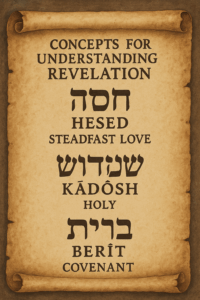
The covenant framework is essential for understanding Revelation
Case Study 1: “God Hardened Pharaoh’s Heart”
To understand how these Hebrew concepts transform our reading of Scripture, let’s examine our first test case: the hardening of Pharaoh’s heart. This example reveals how easily we misinterpret scripture when we lack linguistic and conceptual precision.
The statement “God hardened the heart of Pharaoh” appears repeatedly in Exodus. A surface reading suggests divine manipulation—God forcing Pharaoh to disobey and then punishing him for it. But a closer examination of the Hebrew verbs used tells a different story.
Chazaq: Strengthening Resolve
The most frequently used verb in these passages is chazaq (חָזַק), appearing 13 times. It doesn’t mean “to make stubborn” but “to strengthen” or “to make firm.” This suggests God didn’t create resistance in Pharaoh but strengthened what was already there.
Pharaoh made his initial choice to resist. God’s action was to confirm and solidify this choice, allowing it to reach its full expression. It’s less about changing Pharaoh’s heart and more about strengthening his resolve to follow through on his own decisions.
Khaved: The Weight of Stubbornness
The second verb, khaved (כָּבֵד), used four times, means “to make heavy” or “to make dull.” This implies not manipulation but a natural consequence—Pharaoh’s heart became increasingly unresponsive to moral persuasion.
Think of it as spiritual callouses forming with each act of resistance. God didn’t force this hardening but allowed the natural hardening effect of repeated rebellion to take its course without intervention.
Qashah: Self-Imposed Rigidity
The third verb, qashah (קָשָׁה), used only once, means “to make hard” or “to make stiff.” It describes the final state of someone who has repeatedly chosen resistance until that resistance becomes their fixed character.
The progression in Exodus is revealing. Initially, Pharaoh hardens his own heart. Only later does the text say God hardened it. This suggests that God’s “hardening” was confirming Pharaoh’s freely chosen path, not imposing a new one.
When we understand these Hebrew nuances, we see that the person who hardened Pharaoh’s heart was primarily Pharaoh himself. It’s convenient to blame God, but doing so removes Pharaoh’s responsibility and creates a theological contradiction: it makes God complicit in sin.
Case Study 2: Ananias and Sapphira
Another frequently misunderstood passage that seems to portray God as arbitrary and vindictive is the account of Ananias and Sapphira in Acts 5. This husband and wife sold a piece of property, kept back part of the proceeds while claiming to give all, and subsequently fell down dead after being confronted by Peter.
The Common Misinterpretation
The typical reading of this passage portrays God as executing immediate judgment—striking down Ananias and Sapphira for lying. This interpretation presents God as harsh and retributive, seemingly at odds with the God of hesed revealed throughout scripture. It creates an image of God as a volatile deity who might strike us dead for any misstep—a stark contrast to the patient, loving Father portrayed by Jesus.
But maybe that’s too shallow. Maybe we’ve misunderstood what actually happened in this account.
A Closer Examination
When we examine the text closely, something remarkable emerges. Nowhere does it explicitly state that God killed Ananias and Sapphira. Acts 5:5 simply says, “When Ananias heard these words, he fell down and breathed his last.” Similarly, in verse 10, when Peter confronts Sapphira, it says, “Immediately she fell down at his feet and breathed her last.”
The text describes what happened but does not explicitly attribute their deaths to direct divine intervention. This is significant because in scripture, when making theological claims, precision matters. The text tells us what happened, not necessarily why it happened.
The Greek phrase used—“he fell down and breathed his last” (ἔπεσεν καὶ ἐξέψυξεν)—is a description of what happened, not an attribution of cause. It describes the event without assigning divine agency.
Natural Consequences, Not Divine Execution
What if Ananias and Sapphira experienced the natural consequences of their own actions? Consider the context: they had deliberately planned to deceive the apostles and the Holy Spirit. When confronted with the reality of their deception—when truth collided with falsehood—the shock may have triggered a fatal physiological response.
Medical literature documents cases where extreme shame, fear, or shock has triggered fatal cardiac events. What if their deaths were the natural result of the extreme stress and shame of having their carefully constructed deception suddenly exposed?
This interpretation aligns with the concept of kadosh (holiness) we’ve explored. When we encounter true holiness—as Ananias and Sapphira did when confronted by Peter, filled with the Holy Spirit—there is an invitation to surrender to it. Their resistance to that holiness, their attempt to deceive the Spirit of truth, created an internal fracture that had physical consequences.
This reading preserves God’s consistent character. It doesn’t require us to believe that the God who is “slow to anger, abounding in love” suddenly and arbitrarily executed two people for a sin that, while serious, was certainly not unique in human history.
Instead, we see the unveiling of what happens when deception collides with truth, when human resistance encounters divine holiness. It’s not God changing His character but humans experiencing the natural consequences of resisting reality itself.

When truth collides with deception, natural consequences follow
Case Study 3: Herod in Acts 12
Let’s examine a third passage that, on surface reading, seems to contradict our understanding of God’s unchanging nature: the death of Herod Agrippa I in Acts 12:23, where the text states, “Immediately, an angel of the Lord struck him down, because he did not give God the glory, and he was eaten by worms and breathed his last.”
The Conventional Reading
The traditional interpretation of this passage sees God directly executing Herod for his blasphemous pride. This reading seems supported by the explicit statement that “an angel of the Lord struck him down.” Unlike the case of Ananias and Sapphira, here the text appears to assign clear divine agency to Herod’s death.
This conventional reading creates a troubling portrait: God dispatches an angelic assassin to strike down a human being who failed to give proper glory to God. It suggests a deity whose ego is so fragile that He responds to human pride with lethal force—a far cry from the patient, merciful God revealed throughout scripture.
But maybe that’s too shallow. Maybe we’ve misunderstood what the text is actually telling us.
The Theological Contradiction
If we interpret this passage as God directly killing Herod, we create profound contradictions with the Hebrew concepts that frame our understanding of God’s character:
- Contradiction of Qadosh (Holiness): God’s holiness is His pure, unchanging essence. It unravels rebellion and transforms those who align with it. A holy being cannot directly engage in a physical act of destruction like killing, as that would be an unholy act from a human perspective. While holiness has a consuming effect on sin, as seen in Isaiah’s vision, it is a spiritual truth, not a physical act of violence. Attributing Herod’s death to God’s direct strike compromises His purity.
- Contradiction of Hesed (Steadfast Love): The Lamb’s nature is defined by hesed—steadfast, self-giving love. This is the same love that gives grace before judgment and seeks to restore rather than destroy. Assigning the act of killing to God contradicts the very love that makes Him worthy of worship.
- Contradiction of Berith (Covenant Faithfulness): God is faithful to His established laws. A central principle is that the consequences of humanity’s choices manifest automatically, without divine interference. Attributing Herod’s death to a direct, punitive strike from a divine agent is a form of interference. It suggests God must step outside of His own established spiritual law of cause and effect to enforce a consequence.
Reframing Our Understanding
Given these contradictions, how might we better understand this passage? The key lies in recognizing metaphorical language and understanding divine law as a system of natural consequences, not arbitrary punishment.
The phrase “an angel of the Lord struck him” need not be interpreted as a literal, physical assault. The common translation of this passage can be misleading. In biblical language, angels often function as messengers or agents of divine reality. The “striking” might refer not to a physical blow but to the unveiling or revealing of truth that Herod had resisted.
The term “struck him” may be a metaphor for a spiritual truth made manifest in a physical consequence. The “angel of the Lord” could be seen as an agent of God’s revealed truth, which, in the face of Herod’s hubris and rejection of that truth, caused his physical body to break down.
In this light, the angel doesn’t function as an assassin but as a revelatory agent—making manifest the consequences of Herod’s own choices. When Herod accepted worship that belonged only to God, he placed himself in fundamental opposition to reality itself. The “striking” was the revelation of this contradiction, which had physical consequences.
The passage could be understood as a revelation of the inevitable result of Herod’s actions. His pride and hubris led him to accept worship that belonged only to God. This violation of divine law had a direct, automatic consequence that was simply unveiled by the “angel of the Lord.” It’s not that God intervened to kill him, but that the spiritual law that Herod broke caused his body to perish. The angel, in this sense, is not an agent of violence but a revelatory agent, making manifest the consequence of Herod’s actions.
The description of Herod being “eaten by worms” suggests he died from a physical ailment—possibly what medical literature would identify as intestinal worms leading to peritonitis, a known and painful condition in the ancient world. What if Herod’s condition was already present, and the stress of his public humiliation—the revelation of his pride before the crowd—accelerated the physical breakdown that was already underway?
This interpretation preserves God’s consistent character. It doesn’t require us to believe that the God who is hesed, kadosh, and berith suddenly became a vengeful deity who strikes down humans who offend His honor. Instead, we see the unveiling of what happens when human pride collides with divine truth—not God changing His character but Herod experiencing the natural consequences of placing himself in opposition to reality.
In this light, we are not changing the scripture but correcting our interpretation of it. The flaw lies in our human tendency to project our own desire for punitive justice onto a divine being, thereby attributing to Him a characteristic that is contrary to His unchanging, holy, and loving nature.
Revelation Often Misunderstood
Just as we’ve often misunderstood the hardening of Pharaoh’s heart, the deaths of Ananias and Sapphira, and the striking down of Herod, we’ve frequently misread Revelation. We’ve approached it as a text of divine vengeance rather than covenant fulfillment. We’ve seen its imagery as literal predictions rather than symbolic representations of deeper truths.
Revelation is often treated as an outlier in scripture—a strange apocalyptic text disconnected from the rest of the biblical narrative. But through the lenses of hesed, kadosh, and berith, we can see it as the perfect culmination of God’s story.
The book’s very name in Greek—apokalypsis—doesn’t mean catastrophe but “unveiling” or “revelation.” It pulls back the curtain on reality, showing what happens when creation embraces or rejects its Creator. It reveals not an arbitrary future but the inevitable consequences of our relationship to holiness.
Consider these common misunderstandings about Revelation:
- Mistake #1: Reading Revelation as primarily about the end of the world
- Mistake #2: Interpreting its imagery as literal rather than symbolic
- Mistake #3: Seeing God’s character as different in Revelation than elsewhere in scripture
- Mistake #4: Focusing on timeline predictions rather than theological truths
- Mistake #5: Missing the covenant context that frames the entire book

Revelation unveils reality rather than merely predicting catastrophe
God Unchanged: From Genesis to Revelation
For our interpretation of Revelation to be sound, we must recognize that God cannot change. He is the same God hovering over the waters in Genesis as He is in the dramatic scenes of Revelation. If we find ourselves creating a different God in Revelation—one who contradicts His nature revealed elsewhere—we’ve misunderstood the text.
The God who is hesed, kadosh, and berith in Genesis remains so in Revelation. His covenant faithfulness doesn’t disappear. His holiness doesn’t transform from relational wholeness to distant, angry purity. His covenant commitments don’t dissolve into arbitrary judgments.
When we read of God’s wrath in Revelation, we must understand it through these Hebrew concepts. Divine wrath isn’t emotional rage but the loving, holy, covenant determination to remove everything that destroys creation and relationship.
As Hebrews 13:8 reminds us, “Jesus Christ is the same yesterday and today and forever.” This unchanging nature must be our interpretive key to understanding all of scripture, including its most challenging passages.
The Gravitational Pull of Holiness
Revelation shows us what happens when creation resists the gravitational pull of God’s holiness. Like Pharaoh, like Ananias and Sapphira, like Herod, those who repeatedly harden themselves against God’s invitation experience the natural consequences of that resistance.
The catastrophes in Revelation aren’t God’s vindictive punishment but the unveiling of what happens when we consistently choose to live contrary to reality’s deepest structures. When we reject hesed, we experience its absence. When we resist kadosh, we fragment ourselves. When we violate berith, we step outside its protection.
The plagues, beasts, and judgments of Revelation aren’t God losing control but God revealing the natural order of things. They show what creation becomes when it rejects its Creator—not because God petulantly destroys what doesn’t obey Him, but because creation cannot sustain itself apart from its source.
Think of it this way: God’s holiness creates a gravitational field that draws all creation toward wholeness. To resist this pull is like trying to defy gravity—it requires enormous energy and ultimately fails. The consequences aren’t arbitrary punishment but the natural result of resisting reality’s fundamental structure.
Revelation as Unveiling, Not Just Judgment
Through the Hebrew concepts of hesed, kadosh, and berith, we can reframe our understanding of Revelation from a book primarily about judgment to one about unveiling reality.
Revelation unveils:
- The true nature of evil—not just as breaking rules but as corrupting relationship, purity, and covenant
- The consequences of resistance to God—not arbitrary punishment but the natural unraveling that occurs
- The faithfulness of God—not changing His character but fulfilling it perfectly
- The final restoration of creation—not abandonment but complete renewal
The dramatic imagery of Revelation isn’t meant to terrify but to reveal. It shows us both the depth of evil’s corruption and the greater depth of God’s commitment to restore all things.
When we read of the Beast, the False Prophet, and Babylon the Great, we’re seeing unveilings of how evil operates—through power, deception, and systemic corruption. When we read of seals broken, trumpets sounding, and bowls poured out, we’re witnessing the unveiling of consequences, not the implementation of arbitrary punishments.
This unveiling reaches its climax not in destruction but in recreation—a new heaven and new earth where God dwells with His people. This is the ultimate expression of hesed, kadosh, and berith—covenant faithfulness, holy wholeness, and binding promise fulfilled.
Practical Implications for Readers Today
This reframing of Scripture through Hebrew concepts has profound implications for how we live today:
- It challenges us to examine our resistance. Where are we hardening our hearts like Pharaoh, living in deception like Ananias and Sapphira, or elevating ourselves like Herod, resisting the gravitational pull of holiness?
- It reorients our understanding of judgment. God’s judgments aren’t arbitrary punishments but the loving removal of everything that destroys relationship.
- It offers hope amidst apparent chaos. What looks like the world unraveling may actually be God’s faithfulness at work, removing what cannot remain in a restored creation.
- It invites surrender rather than fear. Instead of dreading God’s holiness, we can embrace it as the source of our wholeness.
- It reveals the consistency of God’s character. We need not fear that God will suddenly change from loving to vengeful. His actions in Scripture are consistent with His covenant faithfulness from the beginning.
This understanding transforms how we read the news, interpret our personal struggles, and face global challenges. It invites us to ask: Where am I resisting the gravitational pull of holiness in my own life? What would it look like to surrender to it—not in fear, but in love?

Surrendering to holiness leads to wholeness, not destruction
Conclusion: A Fresh Reading
By approaching Scripture through these Hebrew concepts, we gain a fresh reading that resolves many of its apparent contradictions. We see not a God who inexplicably changes from love to wrath but a God whose very love necessitates the removal of everything that destroys what He loves.
Revelation is not God’s abandonment of hesed, kadosh, and berith but their ultimate fulfillment. It shows us not an arbitrary future but the inevitable consequences of either embracing or resisting the God who remains consistent from Genesis to Revelation.
In the end, Revelation isn’t primarily about destruction but recreation. Its final vision isn’t desolation but a new heaven and new earth where God dwells with His people in perfect covenant relationship—the ultimate expression of hesed, kadosh, and berith.
This fresh reading invites us not to fear the future but to embrace the God who remains faithful to His covenant promises, whose holiness draws us toward wholeness, and whose love will ultimately restore all things.
Related Resources:
- Understanding Hebrew Concepts in Scripture
- The God of Both Testaments: Finding Consistency in Scripture
- Apocalyptic Literature: A Guide to Biblical Symbolism
- The Book of Revelation: A Fresh Approach
Call to Action:
How has this perspective changed your understanding of Scripture? Share your thoughts in the comments below or join our online discussion group to explore these concepts further.
Author

