Revelation Viewed Through the Lens of Gethsemane

Introduction
Revelation’s figure of the Lamb has long been a subject of theological debate and interpretation. Traditionally, many have understood the Lamb’s authority as a display of divine power characterized by judgment, wrath, and physical conquest. This view often aligns with Dispensationalist theology, which emphasizes a literal and violent end-times scenario where the Lamb enacts retributive justice through physical force and destruction. However, a closer examination of the events in Gethsemane—the garden where Jesus agonized over His impending suffering—offers a compelling alternative perspective. This perspective highlights the Lamb’s authority as spiritual, chosen, and redemptive, rooted in human obedience and voluntary surrender rather than coercive power.
This summary explores the tension between these two interpretations, arguing that the authority of the Lamb must be understood in continuity with the human experience of Jesus in Gethsemane. The Lamb’s power is not a sudden shift to divine wrath but a consistent expression of covenantal fidelity, moral transcendence, and transformative love. To interpret the Lamb otherwise is to risk betraying the very nature of Christ’s human will and the redemptive purpose that underpins His mission.
Revelation’s conflict of Two Lambs
At the heart of the debate lies a fundamental disagreement about the nature of the Lamb’s character and the means by which His authority is exercised. Two distinct theological frameworks offer contrasting pictures.
Gethsemane Theology: Obedience Through Choice

The Gethsemane-centered theology focuses on Jesus’ deeply human struggle and His conscious decision to obey God’s will despite immense suffering. In Matthew 26:38, Jesus expresses profound anguish, revealing that His obedience is not automatic or detached but earned through suffering and choice. Hebrews 5:8 further emphasizes this by stating, “He learned obedience through what He suffered.” This obedience is not a passive submission but an active, prayerful surrender that aligns human will with divine will.
In this view, power is defined not by domination or destruction but by chosen surrender and faithfulness. Jesus’ vulnerability and identification with humanity become the model for redemption. His example teaches that true agency involves empathy and moral responsibility, where victory is achieved through spiritual and ethical transcendence rather than physical force. The ultimate weapon is prayer and the Word of God, symbolizing a spiritual battle fought through faith and love.
Traditional Dispensational Interpretation: Divine Retribution
In contrast, the traditional Dispensational view interprets the Lamb’s authority as a manifestation of divine wrath and judgment. This perspective envisions the Lamb as a warrior who unleashes punitive destruction on His enemies during the final battle of Armageddon. Power here is raw, physical, and coercive, characterized by military conquest and the imposition of divine will through violence.
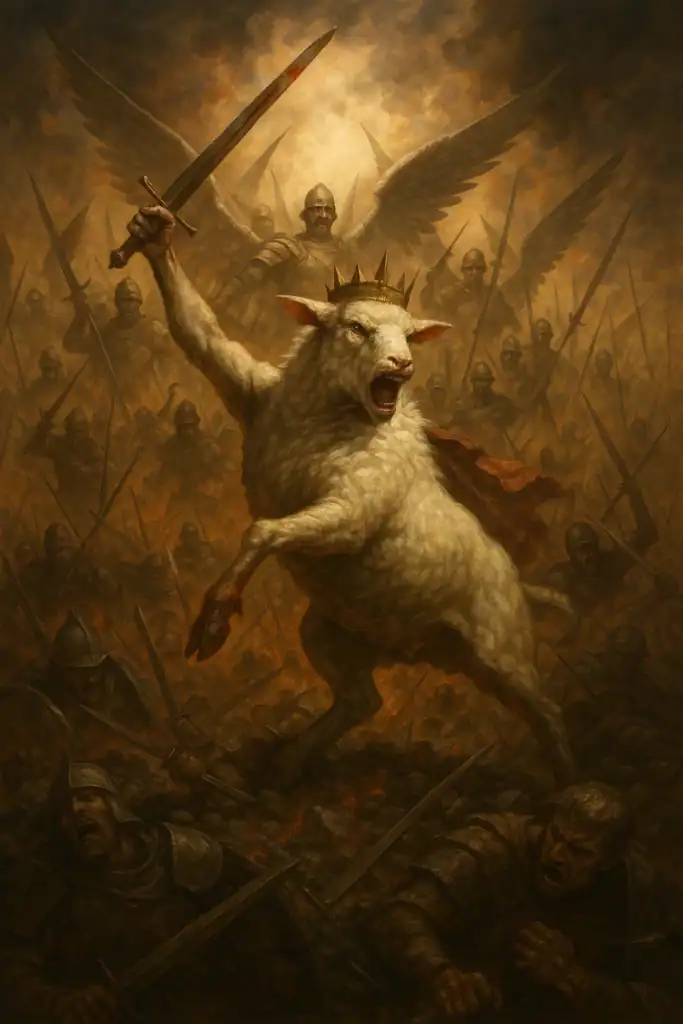
Judgment is understood as a predetermined, global punishment executed by an omnipotent and detached God. The Lamb’s return is accompanied by literal armies and bloodshed, emphasizing physical annihilation as the means of victory. Agency in this framework is automatic and imposed, reflecting a God who acts decisively and without human-like empathy or choice.
The Contradiction: A Clash of Characters
These two interpretations present a stark contradiction in how the Lamb’s authority is understood. The Gethsemane view centers on human choice, suffering, and obedience, portraying power as moral and redemptive. The traditional view emphasizes divine retribution, physical force, and imposed will.
This contradiction extends to several dimensions:
Nature of Power: Chosen Surrender vs. Destructive Domination
The Gethsemane perspective understands power as the strength found in voluntary surrender and faithful obedience. This power is not about overwhelming others through force but about mastering oneself and aligning one’s will with a higher divine purpose. It is a power that is cultivated through suffering and moral resolve, reflecting a deep inner transformation. Jesus’ prayerful submission in Gethsemane exemplifies this, showing that true authority comes from the willingness to choose love and obedience even when it entails great personal cost.
In contrast, the traditional view defines power as the ability to dominate and destroy enemies through sheer force. This power is external and coercive, relying on physical might and military conquest to impose divine will. The Lamb’s authority is expressed through violent judgment and the eradication of opposition, emphasizing control and retribution rather than empathy or moral choice.
These opposing understandings reveal fundamentally different conceptions of what it means to be powerful. One sees power as relational and redemptive; the other sees it as absolute and punitive.
Means of Redemption: Identification and Empathy vs. Detached Omnipotence
Redemption in the Gethsemane framework is achieved through identification with human suffering and empathetic solidarity. Jesus’ experience in the garden reveals a God who enters fully into human pain and struggle, choosing obedience through love rather than coercion. This identification makes redemption accessible and meaningful, as it invites humans to participate in a process of transformation grounded in empathy and moral choice.
Conversely, the traditional Dispensational interpretation views redemption as a divine act of judgment carried out by an omnipotent, detached God. Redemption is imposed from above, often through catastrophic events that punish the wicked and vindicate the righteous. This approach emphasizes God’s sovereignty and power but risks alienating human agency by portraying redemption as something done to people rather than with them.
The difference here is profound: one model sees redemption as a shared journey of transformation; the other as a unilateral act of divine enforcement.
Agency: Centered on Choice and Empathy vs. Automatic Divine Imposition
Agency in the Gethsemane view is deeply connected to human freedom and the capacity to choose obedience and love. Jesus’ struggle and ultimate surrender in the garden highlight the importance of agency as a moral and spiritual reality. Redemption restores and honors this agency, inviting humans to freely participate in God’s redemptive work.
In contrast, the traditional view minimizes human agency by emphasizing automatic divine action. The Lamb’s authority is exercised through predetermined judgment and physical conquest, leaving little room for human choice or moral engagement. This portrayal risks reducing humans to passive recipients of divine will rather than active participants in redemption.
This distinction affects how believers understand their role in the spiritual journey—either as empowered agents of faith or as subjects of divine decree.
Weapons: The Word of God vs. Physical Weapons
The Gethsemane perspective sees the Lamb’s primary weapon as the Word of God, a spiritual and moral force that transforms hearts and minds. This weapon symbolizes truth, love, and obedience, wielded through prayer and faith rather than violence. It reflects a battle fought on the level of conscience and spirit.
By contrast, the traditional interpretation imagines the Lamb wielding literal physical weapons, engaging in warfare that results in bloodshed and destruction. This imagery emphasizes tangible, violent conflict and the use of force to achieve victory.
The choice of weaponry reflects the underlying theology of power and authority: spiritual transformation versus physical domination.
Nature of Victory: Moral Transcendence vs. Physical Annihilation
Finally, the nature of victory differs sharply between the two views. The Gethsemane theology envisions victory as moral and spiritual transcendence—overcoming evil through love, obedience, and sacrifice. This victory is lasting because it changes the hearts of individuals and communities.
The traditional view sees victory as the physical annihilation of enemies, a decisive military conquest that ends opposition through force. While effective in a literal sense, this victory may not address the deeper moral and spiritual issues at stake.
The contrast highlights two fundamentally different understandings of what it means to triumph: one rooted in transformation, the other in destruction.
Gethsemane Undercuts the Traditional View
The Gethsemane thesis challenges the literal and violent interpretation of the Lamb’s return by insisting that Christ’s highest act of power must be consistent with His decisive act in Gethsemane. The agony and chosen obedience in the garden set a precedent that cannot be abandoned in the final revelation of the Lamb’s authority.
Inconsistency of Character: The Immutability Problem
The traditional view requires Jesus to abandon His humanly chosen obedience and become a figure of divine fury and wrath. This shift creates a theological inconsistency. If the Lamb’s authority is rooted in His human decision to obey God, then His final acts must reflect the same character of chosen, redemptive surrender.
A Christ who chooses love and submission in Gethsemane cannot suddenly choose vengeance and destruction in Revelation without undermining the integrity of His human identity. Such a contradiction would challenge the coherence of Christ’s personhood and the nature of His mission.
Inconsistency of Power: The Discipleship Problem
If the Lamb’s final act is purely a display of divine physical force, it renders His example of obedience in Gethsemane irrelevant for human discipleship. The power demonstrated in the final victory would be unattainable and unrelatable for believers.
Instead, the Lamb triumphs through chosen fidelity, the same Spirit that strengthened Jesus’ human will. This victory is mirrored in the martyrs’ triumph in Revelation 12:11, who overcome by the blood of the Lamb and the word of their testimony. The Lamb’s example remains a model of discipleship based on faithfulness and submission rather than domination.
Inconsistency of Redemption: The Agency Problem
Redemption involves the restoration of human agency and the freedom to choose. If the Lamb’s final act involves physically destroying human armies, it negates the power of redeemed agency and resorts to coercion.
True redemption vindicates love and choice rather than overpowering them. The Lamb’s authority is demonstrated by the unraveling of unholiness as a natural consequence of incompatibility with holiness, not by wielding a literal sword of steel. This spiritual victory respects human freedom and invites transformation rather than imposing it by force.
Conclusion: A Spiritual, Chosen, and Redemptive Authority
The analysis of the Lamb’s authority through the lens of Gethsemane reveals that it must be understood as spiritual, chosen, and redemptive. This authority is a continuous expression of covenantal fidelity, moral courage, and transformative love.
The traditional, literal, and violent interpretation of the Lamb’s final appearance is untenable because it contradicts the human will forged in the agony of Gethsemane. The Lamb’s power does not lie in physical force or destruction but in the transformative power of love, obedience, and moral transcendence.
This understanding offers a coherent and compelling model of Christ’s authority that resonates with human experience and provides a meaningful path to true redemption. It invites believers to follow a Lamb who conquers not by might but by faithful surrender, embodying a power that transforms hearts and restores agency rather than destroying it.
In embracing this spiritual and chosen authority, the Lamb remains a figure of hope, compassion, and ultimate victory through love—a victory that transcends violence and invites all to participate in the redemptive journey.
Author

