The Pale Horse in Revelation
Death’s Unveiling as the Ultimate Consequence of Rebellion
When death rides forth in Revelation, it reveals not God’s abandonment but the natural end of humanity’s chosen path.
Table of Contents
- The Fourth Seal Broken
- The Culmination of Unveiled Truth
- Death as Consequence, Not Punishment
- The Divine Holiness That Demands Truth
- God’s Restraint in Revelation
- Beyond the Conventional Reading
- The Invitation Within Devastation
- Finding Hope in the Shadow of Death
The Fourth Seal Broken
When the Lamb breaks the fourth seal in Revelation 6:7-8, John witnesses a haunting vision:
“When the Lamb opened the fourth seal, I heard the voice of the fourth living creature say, ‘Come!’ I looked, and there before me was a pale horse! Its rider was named Death, and Hades was following close behind him. They were given power over a fourth of the earth to kill by sword, famine and plague, and by the wild beasts of the earth.”
This pale horse—chloros in Greek, a sickly yellow-green like a corpse in decay—carries not just another judgment but the culmination of everything that came before. The rider’s name is Death itself, with Hades—the realm of the dead—following close behind like a shadow that cannot be separated from its source.
But what if this isn’t simply God sending death as punishment? What if this is God revealing the natural endpoint of a path humanity has chosen for itself?
The Culmination of Unveiled Truth
Rejection of Divine Grace
The sequence begins with the White Horse. Interpreters debate its identity—is it Christ or conquest? Maybe it’s neither in isolation. Maybe it represents the final gracious invitation to truth and peace that God extends to humanity.
When people choose self-determination over divine guidance, they reject the very foundation of true life. This isn’t about arbitrary rules, but alignment with who God is. God’s holiness is not a distant purity—it’s a living pursuit that seeks to draw all creation back into harmony, into truth, into love.
The rejection of this grace—this fundamental alignment with reality as God created it—sets everything else in motion.
Rise of Conflict and Violence
The Red Horse naturally follows. When truth is rejected, peace cannot stand. The illusion of harmony without God’s shalom was always just that—an illusion. The Red Horse doesn’t bring violence as much as it reveals the violence already present in a world that has rejected its Creator.
We see this pattern throughout human history. Societies that abandon truth eventually lose peace. Communities that reject the divine foundation for human dignity eventually turn on one another. The violence isn’t God’s doing—it’s the natural consequence of pursuing life apart from the Author of Life.
Reign of Systemic Injustice
Then comes the Black Horse, revealing economic injustice. The scales it carries don’t create inequality—they expose it. The inflated prices for basic necessities alongside protected luxury goods unveil a system already corrupted by human greed and self-interest.
The scarcity isn’t arbitrary punishment—it’s the natural result of conflict, hoarding, and the breakdown of systems designed for human flourishing. When we build economies on greed rather than stewardship, on exploitation rather than cooperation, collapse isn’t punishment—it’s consequence.
And here’s the crux: When we encounter true holiness, we are invited to surrender to it—not in fear, but in love. To resist that invitation is to fracture ourselves, because what we are resisting is the very thing that gives us life, purpose, identity, and wholeness.
Death as Consequence, Not Punishment
The Pale Horse, therefore, isn’t God unleashing death as a new punishment. It’s God removing the veil to show the final, devastating consequence of the path humanity has chosen.
Death doesn’t arrive independent of what came before. It rides in on the back of:
- Rejected truth and grace
- Chosen conflict and violence
- Normalized injustice and exploitation
The “sword, famine, plague, and wild beasts” mentioned in Revelation 6:8 aren’t random instruments of divine torture. They’re the natural outcomes of societal breakdown. War brings famine. Famine brings disease. The collapse of human systems leads to vulnerability against the wild elements of creation.
What we’re seeing isn’t God’s vengeance—it’s God’s unveiling of reality. It’s the divine light illuminating the dark corner we’ve been avoiding, forcing us to look at what we’ve created.
The Divine Holiness That Demands Truth
The Pale Horse’s ride is a powerful expression of God’s Qadosh—His holiness. But divine holiness isn’t about moral fastidiousness or distance from impurity. It’s about truth and integrity at the very core of reality.
God’s holiness cannot coexist with illusion. It cannot allow humanity to believe that:
- Rejection of truth leads to freedom
- Violence leads to security
- Exploitation leads to prosperity
- Death leads to life
The Pale Horse tears away these illusions. It’s a profound act of divine honesty—painful, yes, but necessary. Like a doctor who must reveal a terminal diagnosis, God doesn’t cause the disease by naming it. The revelation is an act of truth-telling, not harm-inflicting.
This is why reading Revelation as simply “God’s judgment on sinners” misses the deeper narrative. It’s not that God is angry and therefore kills people. It’s that God is truthful and therefore reveals the death we’ve chosen for ourselves.
God’s Restraint in Revelation
Even in this devastating vision, we glimpse God’s Hesed—His steadfast love. Notice the limitation placed on the Pale Horse: authority over “a fourth of the earth.” This isn’t total annihilation. It’s a restrained revelation.
This limitation points to divine control even in apparent chaos. Death doesn’t have free rein—it has delegated, limited authority. “They were given power,” the text says, indicating that even in this moment, God remains sovereign.
The world isn’t spinning out of God’s control. Even as He allows the consequences of human choices to unfold, He maintains boundaries. This is His Berith—His covenant faithfulness—still at work even as humanity breaks its side of the covenant relationship.
Death may ride, but it rides on a leash held by the God who will ultimately defeat it.
Beyond the Conventional Reading
Revelation is often interpreted through a lens of divine retribution—God getting even with sinful humanity. But maybe this framework distorts more than it reveals.
What if Revelation isn’t primarily about what God does to humanity, but what God reveals about humanity’s chosen path? What if the seals, trumpets, and bowls aren’t weapons God deploys but veils God removes?
This perspective transforms our understanding of God’s role in human suffering. God isn’t the author of death—humanity is. God simply reveals what already exists beneath our carefully constructed illusions.
The Pale Horse doesn’t bring death into a world where it wasn’t already present. It exposes the death that humanity has been cultivating through its collective choices.
This isn’t to diminish human suffering or suggest that individual victims somehow “deserve” their fate. Rather, it’s to recognize that we live in an interconnected moral universe where collective human choices have real consequences that affect the innocent and guilty alike.
The Invitation Within Devastation
Even in the midst of this devastating vision, an invitation remains. The revelation of truth—however painful—creates the possibility of response.
When we see where our path leads—when the veil is torn away and we confront the reality of death that follows rejection, violence, and injustice—we’re faced with a choice: continue or turn back.
This is why Revelation doesn’t end with the Pale Horse. The unveiling of death is part of a larger narrative that culminates in the defeat of death itself. The God who reveals the consequences of human rebellion is the same God who offers the way out of that rebellion.
The invitation isn’t to escape cosmic punishment. It’s to realign with the truth of who God is and who we are created to be. It’s to surrender to the gravitational pull of holiness that we’ve been resisting.
Finding Hope in the Shadow of Death
The Pale Horse vision isn’t the end of the story. It’s a critical turning point in humanity’s understanding of its own condition. By revealing the ultimate consequence of rebellion, God creates space for genuine repentance.
This is why Revelation includes interludes of hope amidst its visions of devastation. The sealed servants in chapter 7, the two witnesses in chapter 11, the woman and her child in chapter 12—all point to God’s ongoing work of preservation and redemption even as human systems collapse.
The hope isn’t that we can avoid facing the consequences of human rebellion. The hope is that:
- God reveals these consequences before they reach their full culmination
- God provides a way through death to life
- God promises a final defeat of death itself
When John later sees death and Hades thrown into the lake of fire (Revelation 20:14), he’s witnessing the ultimate effects of the Pale Horse and its rider. The temporary authority granted to death gives way to the eternal authority of the One who conquered death.
This is the narrative arc that gives meaning to the devastating vision of the Pale Horse. It’s not an isolated judgment but part of a larger story of revelation, response, and redemption.
The Pale Horse of Revelation challenges our understanding of divine judgment. It invites us to see beyond simplistic views of an angry God punishing sinful humans. Instead, it reveals a God of truth who loves us enough to show us the real consequences of our choices—not to condemn us, but to call us back.
When we see the Pale Horse for what it truly is—the unveiling of death as the consequence of human rebellion rather than the expression of divine vengeance—we gain a clearer picture of both human responsibility and divine mercy.
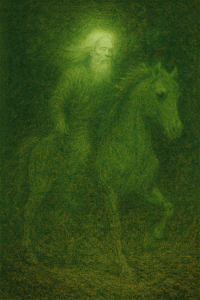
This vision calls us not merely to fear judgment but to embrace the life offered by the One who breaks the seals. It invites us to stop resisting the gravitational pull of holiness and instead surrender to it—not in fear, but in love.
How has your understanding of divine judgment evolved over time? Share your thoughts in the comments below or join our online study group exploring these themes in depth.
? Revelation Reframed — a chapter-by-chapter guide

?️ Theology of the Lamb — a theological deep dive
Author

