The Book of Revelation is one of the most misunderstood books in the Bible. Written during a time of persecution under the Roman Empire, Revelation uses powerful imagery to reveal spiritual realities about power, justice, and the kingdom of God. This guide provides an overview of Revelation’s structure, themes, and historical setting to help readers understand what the book is truly revealing.
Introduction: Author, Purpose, and How to Read Revelation
• Author, Purpose, and Trust
• Historical Interpretive Lenses
• The Throne Room and Relational Consequences
• Historical Context and Resistance Literature
• To Reveal, Encourage, and Anchor in Covenant
• The Voice, the Vision, and the Commission
Christ and the Seven Churches (Revelation 1-3)
Christ first speaks the word of truth to His churches. Revelation begins not with punishment but with revelation—the unveiling of spiritual reality through the searching voice of the risen King.
• The Covenant King’s Inspection
• Faithfulness in Suffering and Compromise
• The King Who Searches Hearts
• Spiritual Death, Stability, and Lukewarmness
• The King at the Door
The Throne Room and the Scroll of Destiny (Revelation 4-5)
Before the Lamb breaks a single seal, Revelation anchors the entire vision in the unchanging nature of God. The One seated on the throne is the One “who was, and is, and is to come.” If God does not change, then the unfolding visions cannot represent a new divine temperament. They must instead reveal how the same holy, covenant-faithful God interacts with a world that has chosen to live outside His order.
- The Divine Summons to the Throne
- The Unchanging God on the Throne (Immutability)
- Creation’s Worship and the Heavenly Court
- The Crisis of the Sealed Scroll
- The New Song and the Lamb’s Deity
The Seven Seals and the Unveiling of Human History (Revelation 6-7)
- The White Horse — Truth Riding Forth
- The Red Horse — Violence and Human Conflict
- The Black Horse — Economic Exploitation and Scarcity
- The Pale Horse — Death as the Outcome of Broken Systems
• The Lamb Opens the Seals and Unveils Consequences
• Martyrdom and the Shattering of Illusion
• The Sealing of God’s Covenant People
• The Church Triumphant
The Trumpet Judgments and the Call to Repentance (Revelation 8-10)
• Prayer, Silence, and Merciful Warning
• Demonic Torment and Hardened Hearts
• The Prophet’s Bittersweet Commission
• The Church’s Measured Testimony
• The Path of the Witnesses and the Final Kingdom
The Cosmic Conflict and the Rise of the Beast (Revelation 12-13)
• The Kingdom Proclamation and Cosmic Conflict
• The Decisive Victory of the Messiah
• Empire, Propaganda, and the Unholy Trinity
• The Mark of Allegiance and the Call for Discernment
Heaven’s Response and the Exposure of Empire (Revelation 14-16)
• The Divine Counter-Narrative
• Proclamations from Heaven
• The Final Harvest and the Justice of God
The Fall and Unmasking of Babylon (Revelation 17-18)
• The Heavenly Prelude to Wrath
• The Total Dismantling of the Beast’s Kingdom
• The Unmasking of Babylon: Seduction and Coercion
• The Funeral Dirge and the Call to Separation
The Final Victory and Judgment of God (Revelation 19-20)
• The Victory of Justice and the Marriage of the Lamb
• The Divine Warrior and the Defeat of the Enemy
• The Millennium and the Final Judgment
The New Creation and the Renewal of All Things (Revelation 21-22)
• Paradise Regained: The New Jerusalem
• The River of Life and the End of the Curse
• The Final Invitation and the Mandate for Witness
Commentary Introduction: Section Summaries
Author, Purpose, and Trust (I, II)
This section argues that understanding the author’s identity—John, traditionally identified as the Apostle—is crucial for reading Revelation correctly. The author wrote not a confusing riddle, but a pastoral letter to real believers enduring a crisis (likely Roman persecution under Domitian). Knowing the book is rooted in history and written by a trusted, faithful witness who received a vision from Jesus helps readers trust its message. Though the style differs from John’s Gospel, the themes of spiritual authority and Jesus as the Lamb resonate, establishing the book’s purpose as one of comfort, correction, and covenant hope.
Historical Interpretive Lenses (III)
The text outlines the four main schools of interpretation for Revelation, arguing that understanding them prevents confusion.
• Preterist: Sees fulfillment in the First Century (e.g., the Beast is Nero/Rome), anchoring the message in its original context.
• Historicist: Sees a symbolic panorama of Church history from John’s time to the end, emphasizing God’s sovereignty over all ages.
• Futurist: Focuses on a literal, future fulfillment (post-Chapter 4), common in modern dispensational theology, highlighting Christ’s eventual return.
• Idealist: Reads the book as a timeless spiritual allegory of the struggle between good and evil, focusing on theological principles relevant to every generation. The commentary’s approach seeks the theological center undergirding all four: the unchanging character of God.
The Throne Room and Relational Consequences (IV)
Chapter 4 is presented as “Command Central,” critical for understanding the rest of Revelation. The text re-frames the judgments not as acts of divine wrath, but as relational consequences resulting from human resistance to God’s presence. What emanates from the throne (truth, holiness, love, warning) is pure and non-punitive. However, when this covenantal fire and light encounters human rebellion, pride, and denial, it is refracted through that resistance and manifests as the devastation and judgment described later. The structure is thus a spiral of invitation and deflection, not a linear ladder of punishment.
Historical Context and Resistance Literature (V, VI, VII)
These sections emphasize that Revelation is resistance literature written in a time of crisis (AD 90–95) under the Roman Emperor Domitian, who demanded emperor worship. For the seven churches, refusing to say “Caesar is Lord” led to persecution, economic exclusion, and exile, as John himself experienced on Patmos. The visions were given to expose the present reality—that the Lamb, not Caesar, is on the true throne—and to empower suffering believers to stand firm and stay awake amid external hostility and internal compromise.
Purpose: To Reveal, Encourage, and Anchor in Covenant (VIII, IX)
The true purpose of Revelation is not to frighten, but to strengthen (Greek: apokalypsis, “unveiling”). It was given to a church in its “worst hour” to anchor them in faith. The commentary proposes a key interpretive lens: God’s Covenant Character, seen through three core concepts:
• Steadfast Love (ḥesed): God’s loyal, merciful love that still cries “Come!”
• Purifying Holiness (qadosh): The burning purity that calls the church to return and drives out deception.
• Covenant Faithfulness (bĕrith): The unbreakable promise, fulfilled in Revelation 21:3 (“Now the dwelling of God is with mankind”). Through this lens, judgments are seen as invitations to return, and the end of the story is the completion of God’s promise.
The Voice, The Vision, and The Commission (X, XI, XII, XIII)
The book is fundamentally a message from a pastor’s heart—John, “your brother and companion in the suffering.” He writes not from detachment, but from shared pain (Patmos) to prepare the churches for faithfulness, not fear. Revelation is “pastoral fire” that lifts the eyes of the terrified church to the true throne and the victorious Lamb. The message still matters today because “empire-thinking” (the system rewarding pride and persecuting truth) is a recurring pattern. The book’s final call is an invitation: “Come out from her… Don’t fear the dragon… The Spirit and the Bride say, ‘Come.’”
Now the text brings us to the churches—where the King’s presence meets real faithfulness, real fatigue, and real compromise.
The Covenant King’s Inspection (Chapter 2: I, II-A)
This section establishes that the seven letters follow a precise, intentional structure (Address, Self-Identification, Commendation, Rebuke, Exhortation, Call to Hear, Promise), grounding the book’s cosmic visions in real-life struggles. The Letter to Ephesus (a mature, doctrinally sound church) begins with Christ identifying as the sovereign, present Lord who “walks among the seven golden lampstands.” Despite their “hard work and perseverance,” Christ rebukes them for having “forsaken the love you had at first.” The command is to “Repent and do the things you did at first,” or risk losing their status as a light-bearing church. The promise to the overcomer is restoration of communion with God through the “tree of life.”
Faithfulness in Suffering and Compromise (Chapter 2: II-B, II-C)
• The Letter to Smyrna, a city famous for its loyalty to Rome, is the only church to receive no rebuke. Christ identifies as the one “who died and came to life again,” offering profound empathy to believers facing the threat of martyrdom. He affirms their material “poverty” and slanders, declaring, “yet you are rich!” The promise is that the faithful will not be hurt by the “second death.”
• The Letter to Pergamum, the political capital known as the place “where Satan has his throne,” is commended for holding fast to Christ’s name despite the martyrdom of Antipas. The rebuke is for “tolerating compromise”—specifically the “teaching of Balaam”—which allowed believers to integrate into the idolatrous imperial system for security. The covenant promise offers “hidden manna” and a “white stone with a new name”—a secret, true identity superior to that offered by the empire.
The King Who Searches Hearts (Chapter 2: II-D, IV-A)
• The Letter to Thyatira, a “blue-collar” city dominated by trade guilds that demanded idolatrous participation, is praised for their “growing love” and increasing works. The tragic rebuke is for “tolerating that woman Jezebel,” a prophetess misleading the church into economic compromise (idol food) and immorality. Christ’s “eyes are like blazing fire,” demonstrating His transforming holiness as He promises to strike the unrepentant to prove to all churches that “I am he who searches hearts and minds.” The promise is a share in Christ’s “authority over the nations” and the gift of “the morning star.”
• Theological Synthesis focuses on the phrase “I know,” which recurs in every letter. This is not distant knowledge but the intimate, firsthand observation of the glorified Christ walking among His people (Chapter 1). This knowledge is the ultimate expression of His covenant faithfulness, serving as a comfort to the suffering (Smyrna) and an urgent wake-up call to the complacent (Ephesus, Laodicea).
Spiritual Death, Stability, and Lukewarmness (Chapter 3: I, II-A, II-B)
• The Letter to Sardis, a city historically conquered due to overconfident watchmen falling asleep, receives no commendation. Christ identifies as the sovereign distributor of life (“seven spirits”) and delivers the shocking assessment: “you have a reputation of being alive, but you are dead.” The command is “Wake up! Strengthen what remains… and repent.” He warns He will come “like a thief,” shattering their false security. The promise is eternal security: being “dressed in white” and having their name “never blot out… from the book of life.”
• The Letter to Philadelphia, the small, missionary city built on an earthquake fault line, receives no rebuke. Christ affirms their “little strength” but commends their tenacious loyalty (“kept my word and have not denied my name”). He promises them an “open door” for mission that no one can shut, public vindication against their enemies, and permanent security: He will make the overcomer a “pillar in the temple of my God. Never again will they leave it.”
The King at the Door (Chapter 3: II-C, III)
• The Letter to Laodicea, the rich, self-sufficient city, receives the most severe rebuke. Christ identifies as “the Amen, the faithful and true witness” and finds their spiritual state “lukewarm” and nauseating, threatening to vomit them out. They arrogantly claimed, “‘I am rich… and do not need a thing,’” but Christ exposes them as spiritually “wretched, pitiful, poor, blind, and naked,” countering their civic pride. His harsh rebuke is an act of love: “Those whom I love I rebuke and discipline.” He issues the famous plea: “I stand at the door and knock,” offering restored fellowship. The ultimate promise to the overcomer is the right to “sit with me on my throne.”
• Theological Synthesis examines the tension between Christ’s awesome holiness (eyes of fire) and His merciful patience (giving the false prophetess time to repent). This patience is not indifference, but a limited window of grace intended to lead His people to repentance and “realign themselves with His holy nature.”
And then we’re led upward—into the throne room—so we can see what was always governing the chaos below.
The Divine Summons to the Throne (Chapter 4: I, II-A)
Chapter 4 begins the dramatic shift from earth to heaven with a “royal command”—the authoritative summons “Come up here.” This instruction is given to reveal that the judgments that follow are not arbitrary destruction, but the inevitable consequences when the “pure, awesome, and transforming reality of God’s holy, self-giving love” encounters a resistant world built on falsehood. The first sight is the unshakable, occupied Throne of God.
The one on the throne has the appearance of “jasper and ruby” (dazzling purity and consuming fire), encircled by an “emerald rainbow.” This rainbow is the sign of God’s covenant of mercy (Genesis 9), which assures the suffering church that God’s fiery holiness is always encircled by His faithful, unbreakable promises.
Creation’s Worship and the Heavenly Court (Chapter 4: Verse 6a–11)
The vision continues with the “sea of glass, clear as crystal” before the throne, symbolizing the final reality where all chaos and disorder have been eternally removed by God’s holiness. In the center are the Four Living Creatures (representing all creation: lion, ox, man, eagle), covered with eyes (vigilance) and wings (readiness), engaged in perpetual worship: “Holy, holy, holy is the Lord God Almighty.” The twenty-four elders (redeemed humanity) respond to this chorus by falling down and laying their gold crowns before the throne. This act is the ultimate posture of surrender and a powerful expression of steadfast love (ḥesed), acknowledging that all their victory and authority is a derived gift from the Creator. The worship is grounded in God’s worthiness as Creator.
The Crisis of the Sealed Scroll (Chapter 5: I, II, III-Verse 7)
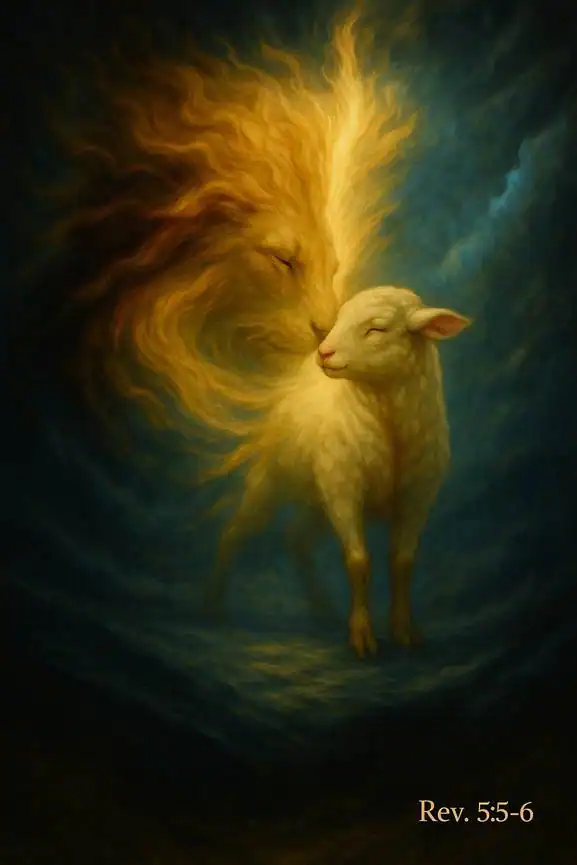
Chapter 5 presents a cosmic crisis: a seven-sealed scroll (God’s redemptive plan for history) is held in God’s right hand, but no one is found worthy to open it. John weeps, fearing God’s plan is stalled. An elder comforts him, announcing the victory of the “Lion of the tribe of Judah, the Root of David”—a conquering king. However, when John turns, he sees, instead of a Lion, a Lamb, “looking as if it had been slain,” yet standing at the center of the throne. This contrast is the theological revelation: the Lamb has triumphed, not by force, but by self-giving sacrifice. He is the only one with the moral and legal authority to take the scroll, confirming that divine authority is defined by self-giving love.
The New Song and the Lamb’s Deity (Chapter 5: C, IV)
The moment the Lamb takes the scroll, the heavenly court erupts in a “new song.” The elders and living creatures fall down, holding harps and golden bowls full of incense (“the prayers of the saints”), demonstrating that earth’s groaning becomes heaven’s worship. The song declares the Lamb’s worthiness: “Because you were slain… and with your blood you purchased for God persons from every tribe and language and people and nation.” The worship expands to an innumerable angelic multitude and finally to “every creature,” all giving the same glory and honor to “him who sits on the throne and to the Lamb.” This shared, highest worship is one of the New Testament’s most explicit affirmations of the Lamb’s full deity.
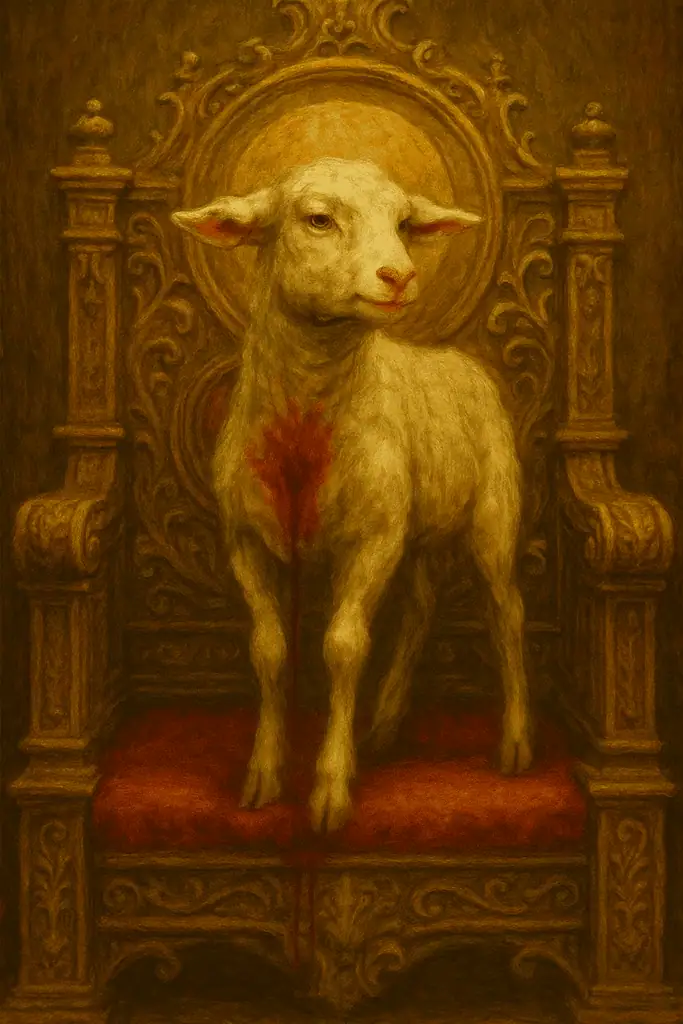
The Lamb standing in the center of the throne changes everything
From here, the vision begins to open what has been sealed—showing what happens when truth is unveiled in a resistant world.
The Lamb Opens the Seals and Unveils Consequences (Chapter 6: I, II-A, II-B)
As Chapter 6 opens, the slain Lamb begins to open the seals. This action must be interpreted through His nature: the seals are not arbitrary punitive wrath, but the unveiling of covenant consequences—the natural outcomes of humanity’s long rejection of God’s order.
• The First Seal unleashes the White Horse (rider wears the victor’s crown, stephanos), symbolizing the advance of divine truth (nikaō, to conquer), which precedes judgment.
• The Subsequent Seals unleash the natural unraveling of a rebellious world: Red Horse (collapse of peace/violence), Black Horse (economic injustice/scarcity), and Pale Horse (death/disorder). The Lamb is the Revealer, not the Destroyer, exposing the anatomy of human rebellion.
Martyrdom and the Shattering of Illusion (Chapter 6: C, D)
The Fifth Seal reveals the “souls of the slain under the altar”—martyrs whose lives were poured out because of their faithful “testimony.” This temple imagery signifies that their sacrifice is received by God as holy and their blood cries out, not for vengeance, but for vindication in accordance with God’s justice. The Sixth Seal brings cosmic confrontation—the sun darkens, the stars fall—signaling the end of illusion and the collapse of the false reality built on self-preservation. The kings, rich, and mighty hide, not from fire, but from the “face of Him who sits on the throne and from the wrath of the Lamb,” realizing their earthly power cannot withstand unveiled divine holiness.
The Sealing of God’s Covenant People (Chapter 7: I, II, A)
The narrative pauses after the shattering sixth seal to answer the question, “Who can stand?” (6:17). This divine interlude in Chapter 7 is an act of covenant faithfulness shifting the focus from judgment to the security of God’s people.
• The four angels are commanded to restrain the winds of judgment until God’s servants are sealed. This delay is an act of mercy demonstrating that God’s first priority is preservation.
• The 144,000 are sealed on their foreheads. This is a symbolic number (12 x 12 x 1000) representing the complete, protected, and multiethnic covenant people of God—the true Israel—who are marked for allegiance to the Lamb amid the world’s crisis.
The Church Triumphant (Chapter 7: Verse 9–17)
The section shifts from the symbolic 144,000 (Church Militant, protected on earth) to the “great multitude that no one could count” (Church Triumphant, victorious in heaven). This multiethnic multitude, “from every nation, tribe, people and language,” stands before the throne, wearing white robes and holding palm branches (symbols of victory and celebration). Their cry, “Salvation belongs to our God… and to the Lamb,” is affirmed by all of heaven. An elder identifies them as those who “have come out of the great tribulation” and have “washed their robes… in the blood of the Lamb”—the central Gospel paradox. Their eternal destiny is the fulfillment of covenant promises (bĕrith): unmediated presence before the throne and perfect provision (“never again will they hunger; never again will they thirst”), with the Lamb as their Shepherd who personally “will wipe away every tear from their eyes.”
Now the scene holds its breath—heaven goes quiet—then prayer rises, and warning sounds with mercy still in it.
Prayer, Silence, and Merciful Warning (Chapter 8: I, II, III-A, B, C)
The Seventh Seal opens with “silence in heaven for about half an hour,” the holy hush of God’s awesome presence. This silence precedes the vision of intercession: an angel offers much incense “with the prayers of all God’s people” on the golden altar, showing that the cries of the suffering saints ascend as a holy, powerful aroma before God. The angel then takes the censer, fills it with fire from the altar (the fire of God’s transforming holiness), and hurls it to the earth. The ensuing trumpet blasts are thus a direct, mercifully severe response to the prayers of the saints, not arbitrary wrath. The First Four Trumpets are partial judgments (affecting only “a third”)—designed as prophetic warnings (echoing the plagues of Egypt) to break the world’s false security and call it to repentance.
Demonic Torment and Hardened Hearts (Chapter 9: I, II, III-A, B, IV)
The Fifth Trumpet (First Woe) unleashes a demonic horde (locusts) from the Abyss—the prison of cosmic evil. God is not creating new evil; He is unveiling the spiritual reality of a world that has rejected Him. The horde is restricted by strict divine limitations: they cannot kill, only torture for a limited time, and only those who do not have the seal of God—a stunning confirmation of the sealed church’s protection. The Sixth Trumpet (Second Woe) unleashes a supernatural army to kill “a third of mankind.” However, the theological climax is the heartbreaking unrepentance (v. 20-21): even after this catastrophic plague, the survivors “still did not repent of the work of their hands.” This reveals the profound hardness of the human heart, which fear cannot change.
The Prophet’s Bittersweet Commission (Chapter 10: I, II, III-A, B, C, IV)
The trumpet sequence pauses for an interlude focused on the prophetic witness. John sees a mighty angel (bearing Christ-like glory) standing with one foot on the sea and one on the land (universal dominion). The angel swears an unbreakable oath that there will be “no more delay” and that the “mystery of God will be accomplished.” John is commanded to take and “eat” the “little scroll,” a direct allusion to Ezekiel’s commissioning that requires the complete internalization of God’s Word. The word is “sweet as honey” (the joy of receiving God’s truth) but turns his stomach “sour” (the bitterness of proclaiming judgment to a rebellious world). John is then recommissioned to “prophesy again.”
The Church’s Measured Testimony (Chapter 11: I, II-1, II-2)
Chapter 11 shifts to the Church’s external mission. John is commanded to measure the temple, altar, and worshipers, an act of divine preservation that symbolically defines and sets apart the true, worshipping covenant people (the Church) from the rebellious “outer court.” The vision introduces the Two Witnesses, symbolic figures who represent the faithful, prophetic Church. Their identity is archetypal (combining the powers of Moses and Elijah), symbolizing the Church’s call to deliver the full, legally valid Testimony (Law and Prophets) of God’s Word. Their clothing in sackcloth shows their witness is one of mournful, repentance-pleading love.
The Path of the Witnesses and the Final Kingdom (Chapter 11: An Exegesis Introduction)
The ministry of the Two Witnesses is the ultimate template for the Church’s mission: courageous, public testimony in a hostile world. Their message provokes the world, leading to their martyrdom at the hands of the “beast,” resulting in temporary global celebration. However, their story mirrors the Lamb’s: they are resurrected and ascend to heaven, publicly vindicated by God. This demonstrates that the path of the witnesses is the path of the Lamb—steadfast love that endures suffering in confidence of the covenant promise of resurrection. The chapter culminates with the Seventh Trumpet sounding, unleashing not a plague, but a thunderous proclamation from heaven that the final victory has been secured and the kingdom belongs to our God and His Christ forever.
This is where the curtain pulls back even further—so the church can see the war behind the world’s wars.
The Church’s Prophetic Path (Revelation 11: Immediate Context, Synthesis)
Revelation 11 details the Church’s mission following John’s bittersweet recommissioning. The command to measure the temple, altar, and worshipers is a symbolic act of divine preservation, distinguishing the true, protected covenant people (the inner temple) from the outer, world-trampled aspects of the holy city. The core is the ministry of the Two Witnesses (symbols of the prophetic Church, embodying the authority of Moses and Elijah), who preach in sackcloth (mourning and repentance) for 1,260 days (the period of trial). Their fate—martyrdom by the Beast from the Abyss, followed by their resurrection and ascension—is the ultimate public vindication of the Church’s testimony, confirming that the path of the witnesses is the path of the Lamb.
The Kingdom Proclamation and Cosmic Conflict (Revelation 11: The Seventh Trumpet, Chapter 12: I–IV)
The vindication of the witnesses is immediately followed by the Seventh Trumpet, which unleashes the climactic proclamation: “The kingdom of the world has become the kingdom of our Lord and of his Christ, and he shall reign forever and ever.” This transitions the vision to Revelation 12, which unveils the cosmic conflict that explains the church’s earthly struggles. The vision features the radiant Woman (symbolizing God’s faithful covenant people, Israel/Church) and the enormous red Dragon (Satan/ancient Serpent, manifested in oppressive empires like Rome). This contrast assures the persecuted church that their struggles are manifestations of a spiritual war against a defeated, enraged adversary.
The Decisive Victory of the Messiah (Revelation 12: Section 5)
The conflict culminates with the birth of the Male Child (Jesus Christ), who is “snatched up to God and to his throne” (an apocalyptic summary of His resurrection and ascension). This enthronement is the decisive victory, immediately triggering the War in Heaven, where Michael and his angels defeat and hurl the Dragon and his angels down to earth. A loud heavenly voice proclaims that the accuser’s authority is revoked. Believers triumph over the Dragon on earth by “the blood of the Lamb” (the objective foundation) and “by the word of their testimony” (the subjective application), even to the point of martyrdom. Woe is proclaimed to the earth, as the Dragon, knowing “his time is short,” directs his temporary fury at the Woman’s “offspring” (the Church).
The Unholy Trinity: Empire and Propaganda (Revelation 13: Introduction, Part 1, Part 2)
Revelation 13 unveils the Dragon’s earthly strategy by introducing the “unholy trinity.”
• The Beast from the Sea (composite of Daniel’s pagan empires, explicitly the Roman Empire) receives its power and throne directly from the Dragon. It is a parody of Christ, especially with its “fatal wound that had been healed” (an allusion to the Nero Redivivus myth). It is the source of coercive state power.
• The Beast from the Earth (the False Prophet), which looks “like a lamb, but it spoke like a dragon,” is the propaganda machine that enforces the worship of the Sea Beast. It performs deceptive signs and requires the world to receive the “mark of the beast” (a mark of total allegiance) to “buy or sell.”
The Mark of Allegiance and Call for Discernment (Revelation 13: The Mark, Synthesis)
The Mark of the Beast (on the right hand or forehead) is the ultimate satanic parody of God’s seal. It symbolizes required participation in the idolatrous economic and civic system (the Imperial Cult and trade guilds) of the Roman Empire, where refusal meant economic ruin and social exclusion. The famous number 666 is widely accepted as the gematria (numerical value) of “Nero Caesar” in Hebrew, rooting the terrifying vision in the specific, historical figure who demanded idolatrous worship. The synthesis urges contemporary readers to use this chapter as a diagnostic tool to identify modern “beasts”—systems that demand total loyalty in exchange for security and belonging—and choose “the patient endurance and faith of the saints” over compromise.
But God does not leave His people under the beast’s story—He speaks a counter-story that anchors identity, loyalty, and hope.
The Divine Counter-Narrative (Revelation 14: Introduction, Context, Exegesis Part 1)
Revelation 14 provides the crucial divine counter-narrative to the beast’s oppressive reign.
• Instead of the Beast on the sea, the Lamb stands triumphantly on Mount Zion (v. 1), the symbol of His unshakable kingdom.
• The 144,000 stand with Him, bearing the Father’s name sealed on their foreheads (divine ownership).
• They sing a “new song” of redemption that only the faithful can learn.
• The 144,000 are characterized by spiritual purity (“virgins”—those who avoided spiritual adultery/idolatry), unwavering loyalty (“follow the Lamb wherever he goes”), and are identified as the “firstfruits”—the initial pledge of God’s final, total redemption. The entire chapter functions as a pastoral anchor assuring the persecuted church of their secure identity and certain victory.
The Proclamations from Heaven (Revelation 14: Part 2)
The vision shifts to three angels broadcasting divine counter-propaganda to the world.
• The First Angel delivers the “eternal gospel,” a universal call to “Fear God… and worship him who made heaven and earth”—the fundamental choice between the Creator and the creature.
• The Second Angel proclaims the radical and certain judgment: “Fallen! Fallen is Babylon the Great!”—a message of hope assuring the persecuted church that their oppressors’ doom is already sealed in heaven.
• The Third Angel issues the dire warning: those who compromise by receiving the Beast’s mark will face the full measure of “God’s fury.” The section concludes with the comfort, “Blessed are the dead who die in the Lord,” assuring martyrs that death is not defeat, but a blessed entry into rest.
The Final Harvest and the Justice of God (Revelation 14: Part 3, Synthesis)
The chapter concludes with two parallel visions of the final harvest, symbolizing the ultimate separation.
• The Grain Harvest (reaped by Christ, “one like a son of man”) represents the gathering of the righteous (the Church Triumphant).
• The Grape Harvest is cast into “the great winepress of God’s wrath,” graphically portraying the complete and final destruction of those aligned with the Beast. The synthesis confirms the chapter’s threefold message of hope: A Proclamation of Identity (sealed as the Lamb’s property on Mount Zion); A Proclamation of Truth (Babylon is certain to fall); and A Proclamation of Justice (the final harvest guarantees that evil will be fully punished). This assures the Church that its endurance is not in vain.
Now the vision gathers itself for what is final—holy preparation before the last judgments fall.
The Heavenly Prelude to Wrath (Revelation 15)
Chapter 15 is the solemn liturgical prelude to the final judgments, establishing their holiness and justice.
• John sees the victorious saints standing on a “sea of glass mixed with fire” (symbolizing safe passage through fiery trial).
• They sing the “Song of Moses and of the Lamb,” explicitly framing the coming judgment as a new, greater Exodus that will defeat the Beast (the new Pharaoh).
• Their song praises God: “Just and true are your ways, King of the nations,” affirming the absolute righteousness of the coming wrath.
• The Heavenly Sanctuary opens, and seven priestly angels emerge to receive “seven golden bowls filled with the wrath of God.” The Sanctuary is filled with smoke, and “no one could enter,” signifying that the time for intercession is over; the time for final, holy justice has come.
The Total Dismantling of the Beast’s Kingdom (Revelation 16)
The Seven Bowls of Wrath are swift, total, and final plagues that systematically dismantle the Beast’s kingdom, contrasting with the partial warnings of the trumpets.
• Bowls 1–4 strike the environment (festering sores, blood in sea/rivers, scorching sun), demonstrating the environment turning against those who worship the Beast.
• Bowls 5 brings darkness to the “throne of the beast,” signifying the collapse of its political authority.
• Bowl 6 dries the Euphrates to gather the world’s armies at Armageddon (the symbolic place of final, decisive defeat) by demonic spirits of deception.
• Bowl 7 is poured into the air, and a voice from the throne cries, “It is done!” (Gegonen), followed by the greatest earthquake in history, signifying the total collapse of all human civilization and the clearing of the stage for Babylon’s judgment.
The Unmasking of Babylon: Seduction and Coercion (Revelation 17)
Chapter 17 unmasks “Babylon the Great” as the “great prostitute,” a figure representing the seductive, corrupting culture and economic allure of empire (specifically Rome).
• She is opulently dressed and “drunk with the blood of the saints,” showing her luxury is fueled by persecution.
• She is riding the scarlet Beast (raw political power). The alliance seems absolute, yet the angel reveals the shocking truth: the Beast and its allies “will hate the prostitute” and violently destroy her.
• This reveals the inherent instability and self-destructive nature of evil. The ultimate message is to place allegiance only in the Lamb, as all worldly systems built on power and seduction will eventually turn on themselves.
The Funeral Dirge and the Call to Separation (Revelation 18)
Revelation 18 is the dramatic funeral lament for the system of Babylon, now declared “Fallen! Fallen!”
• The angelic proclamation and the threefold lament of the kings, merchants, and sea captains (those who profited from her) reveal that her sudden destruction (in “one hour”) is due to her arrogance and economic corruption.
• The detailed inventory of luxury goods climaxes with the indictment that her global economy was built on the “bodies—that is, human souls” (slave trade/human exploitation).
• The chapter culminates in the urgent command to God’s people: “Come out of her, my people,” a call for radical ethical and spiritual separation from the corrupting values and exploitative systems of the doomed world, and an assurance that their final vindication has arrived.
And then the sound changes—lament gives way to hallelujah—because justice clears the way for covenant joy.
The Victory of Justice and the Marriage of the Lamb (Chapter 19: Part 1)
The silence after Babylon’s fall is broken by heaven’s fourfold “Hallelujah” chorus, celebrating that God’s judgments are “true and just.” This righteous judgment immediately transitions to the ultimate celebration: the “wedding supper of the Lamb.” The Bride (the Church) is made ready, clothed in “fine linen… the righteous acts of God’s holy people,” signifying the final, secure, and intimate consummation of the covenant between Christ and His redeemed. The worship is affirmed by the whole heavenly court, reinforcing the theological truth that heavenly joy is rooted in divine justice.
The Divine Warrior and the Defeat of the Enemy (Chapter 19: Part 2, Part 3, Synthesis)
The scene shifts to the appearance of Christ as the Divine Warrior on a white horse, named “Faithful and True” and “The Word of God.” He rides forth with a “sharp sword coming out of his mouth,” signifying that His final victory is accomplished not by physical force, but by the sovereign authority of His Word. The armies of the Beast are gathered at the “great supper of God,” but the ensuing “battle” is an anti-climax: the Beast and the False Prophet are instantly captured and thrown alive into the “fiery lake of burning sulfur.” The synthesis is that Christ’s victory is decisive, total, and executed effortlessly by the power of Truth.
The Millennium and the Final Judgment (Chapter 20: Part 1, Part 2, Part 3, Part 4)
Chapter 20 addresses the problem of evil’s source.
• The Binding: The Dragon (Satan) is bound in the Abyss for “a thousand years” to prevent him from “deceiving the nations,” demonstrating God’s sovereign restraint over evil’s source.
• The Reign: The martyrs (those “beheaded because of their testimony”) are seen alive and reigning with Christ, realizing the first resurrection and experiencing radical vindication.
• The Final Conflict: After the thousand years, Satan is released, gathers the final, symbolic rebellion (Gog and Magog), and is instantly destroyed by fire from heaven.
• The Judgment: The vision culminates in the Great White Throne, where all the dead are judged according to the “books” (of deeds) and the “book of life,” before Death and Hades are destroyed in the lake of fire.
At last, the story turns home—judgment behind us, communion ahead, and God dwelling with His people.
Paradise Regained: The New Jerusalem (Chapter 21: Part 1, Part 2, Synthesis)
After judgment, the old creation flees, and John sees a “new heaven and a new earth,” and the New Jerusalem descending from heaven “like a bride.”
• The ultimate promise is fulfilled: “Look! God’s dwelling place is now among the people, and he will dwell with them.” God personally “will wipe away every tear from their eyes,” and death, mourning, and pain are permanently abolished.
• The city is a perfect cube (the geometry of the Holy of Holies). The most stunning feature is the absence of a temple, because “the Lord God Almighty and the Lamb are its temple.”
• The Synthesis declares that the New Jerusalem solves the three great agonies of existence: Separation (perfect communion), Sorrow (abolition of grief), and Scarcity (limitless provision).
The River of Life and the End of the Curse (Chapter 22: Part 1, Context)
The final chapter unveils the vibrant life within the New Jerusalem, completing the biblical narrative by returning to Eden imagery.
• The “river of the water of life” flows from the throne, and on its banks stands the “tree of life,” freely accessible—signifying the permanent undoing of the Genesis curse.
• The tree bears twelve crops of fruit and its leaves are for the “healing of the nations,” promising ultimate reconciliation and wholeness from all historical division.
• The ultimate promise is fulfilled: God’s servants “will see his face,” the pinnacle of unhindered, eternal communion. This vision gives the believer a powerful picture of Paradise finally and perfectly regained.
The Final Invitation and the Mandate for Witness (Chapter 22: Part 2, Concluding Exegesis, Final Synthesis)
The vision recedes into a final Epilogue, serving as an urgent call to action. The angel and Jesus affirm the trustworthiness of the prophecy and its imminence (“I am coming soon”).
• The definitive promise is followed by the open invitation (v. 17): “The Spirit and the bride say, ‘Come!’ And let the one who is thirsty come; and let the one who wishes take the free gift of the water of life.”
• The Final Synthesis (The Mandate) is distilled into two core points: Revelation gives us Eyes to See (to discern the spiritual war of worship in the present) and a Will to Choose (to choose the path of the Lamb’s sacrifice over the beast’s self-aggrandizement in daily life). The entire Bible concludes with the Church’s prayerful, hopeful response: “Amen. Come, Lord Jesus.”
Author

