Introduction: Beyond the Fear
Mention “The Book of Revelation” in conversation, and you’ll likely witness expressions change. For many, this final book of the Bible evokes images of catastrophe, punishment, and fear. Perhaps no imagery is more iconic—or misunderstood—than the Seven Seals and their Four Horsemen.
But what if everything we thought we knew about the Seals was incomplete?
What if these powerful symbols weren’t primarily about punishment, but invitation? What if, rather than depicting a God eager to unleash wrath, they reveal a God persistently reaching out to humanity even as we experience the consequences of our own choices?
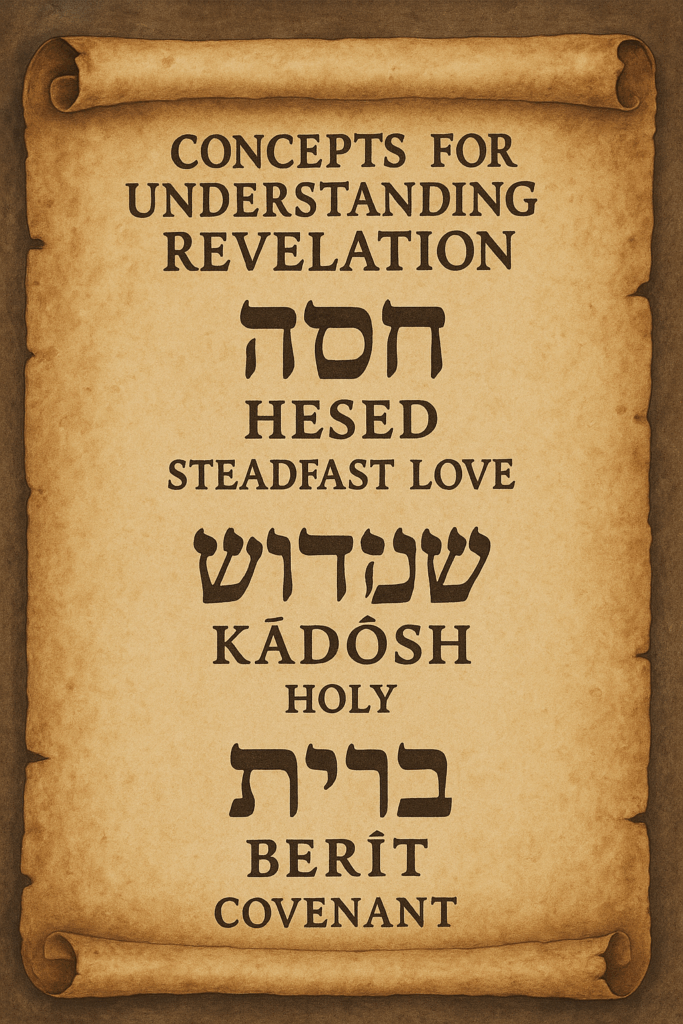
This post introduces a transformative way to understand Revelation’s Seven Seals through three foundational Hebrew concepts that illuminate God’s consistent character throughout Scripture:
- Ḥesed (steadfast love) – God’s persistent, covenant loyalty
- Kadosh (holiness) – God’s perfect, transformative purity
- Berith (covenant) – God’s faithful commitment to relationship
When we apply these lenses to Revelation, something remarkable happens: the frightening images of judgment reveal themselves as profound invitations to return to relationship with the Creator.
The Problem with Traditional Interpretations
For generations, the Seven Seals have been interpreted primarily as instruments of divine wrath—God’s punishment unleashed on a rebellious world. This perspective has shaped doomsday predictions, fear-based preaching, and apocalyptic anxiety.
But this interpretation creates serious theological problems:
- It portrays God as inconsistent—loving in the Gospels but vengeful in Revelation
- It suggests salvation comes through fear rather than invitation
- It contradicts Jesus’ own revelation of God’s character
- It makes the Lamb—a symbol of sacrifice—into an agent of destruction
A Different Approach: Revelation, Not Retribution
A Different Approach: Revelation, Not Punishment
The Greek word “apocalypse” (ἀποκάλυψις) literally means “unveiling” or “revelation.” The Seals, rather than initiating punishment, are unveilings that reveal the true state of human brokenness and the consequences of separation from God.
The Seals aren’t weapons God uses against humanity; they’re divine mirrors reflecting what we’ve done to ourselves and to creation through rebellion against covenant relationship.
The Three Hebrew Concepts That Transform Our Understanding
Ḥesed: God’s Steadfast Love
The Hebrew concept of ḥesed appears 248 times in Scripture, expressing God’s covenant loyalty and unwavering commitment to relationship. Unlike casual kindness, ḥesed represents loyal love that persists even when the recipient is unfaithful.
How Ḥesed Transforms the Seals:
- The Seals reveal God’s persistence in communicating with humanity
- Warnings become expressions of grace, not threats
- God’s patience is demonstrated through incremental revelation
- Even in judgment, God’s ultimate goal is restoration
Just as someone calling out a warning about an approaching snake acts from love, not malice, the Seals represent God’s loving alert to humanity about the consequences of our choices.
Kadosh: God’s Perfect Holiness
In Jewish thought, “The Holy One, blessed be He” (ha’kadosh, barukh hu) is a primary designation for God. Kadosh implies separation and distinction—God’s utter uniqueness and perfect purity.
How Kadosh Transforms the Seals:
- The Seals reveal how sin naturally separates from God’s holiness
- Divine holiness demands the exposure of sin for healing to begin
- Like a surgeon revealing a wound before treating it, the Seals uncover what must be healed
- God’s holiness works toward restoration, not merely punishment
“Whatever holiness truly is, the effect of it is restoration.” The Seals represent the necessary process of divine holiness confronting and transforming that which opposes it.
Berith: God’s Covenant Faithfulness
Biblical covenants establish relationship between God and humanity. Unlike contracts based on performance, covenants create family bonds and establish peace.
How Berith Transforms the Seals:
- The Seals unfold as part of God’s covenant commitment
- The Lamb who opens the Seals embodies perfect covenant-keeping
- Even catastrophic elements demonstrate God addressing sin while extending mercy
- The ultimate goal is restored covenant relationship on a cosmic scale
The right to open the Seals belongs to Jesus Christ specifically because He died for humanity. The Seals are opened not by a God eager for vengeance, but by “the Lamb looking as if it had been slain” (Revelation 5:6).

The Four Horsemen Reframed: Invitation, Not Destruction
When viewed through these Hebrew concepts, the Four Horsemen reveal a progression of consequences resulting from humanity’s broken relationship with God—each one simultaneously revealing truth and inviting return.
The White Horse: Truth’s Advance, Not Deception
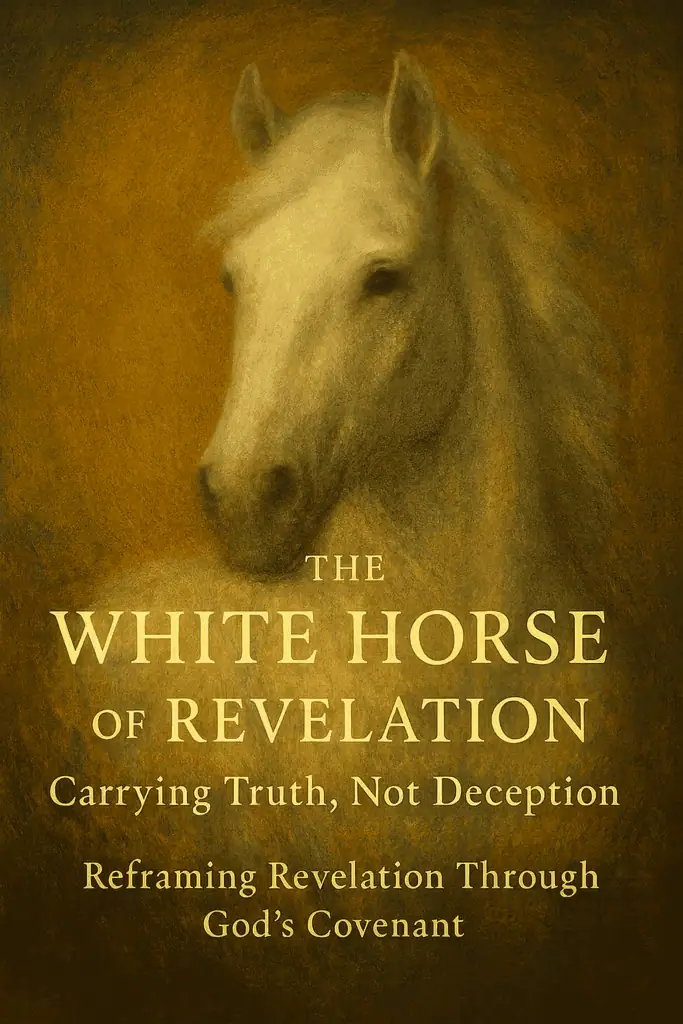
Traditional view: Often interpreted as the Antichrist or false peace
Reframed understanding: The advance of God’s Word and truth in the world
The first Seal reveals a white horse with a rider holding a bow and wearing a victor’s crown (stephanos). Rather than representing deception or conquest, this horseman symbolizes divine truth advancing through human history—a final proclamation before consequences unfold.
Key evidence:
- White consistently symbolizes righteousness and purity in Scripture
- The rider’s crown (stephanos) is the same type given to faithful believers
- The first Seal follows God’s consistent pattern of sending truth before judgment
- In Revelation 19:11-14, Christ Himself appears on a white horse
The Red Horse: Conflict from Rebellion
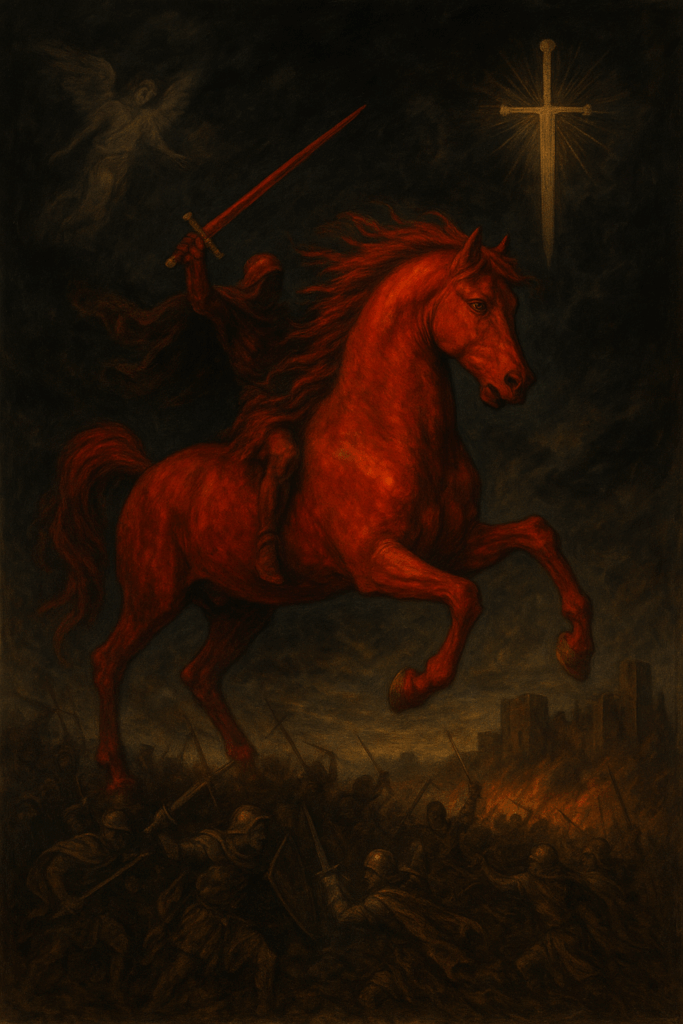
Traditional view: War sent as divine punishment
Reframed understanding: Shalom was never taken, shalom never existed on earth.
The second Seal reveals a rider who “takes peace from the earth” so that people “kill each other.” This isn’t God actively punishing humanity, but revealing what naturally happens when societies reject the reconciling truth of the white horse.
Key insights:
- The rider doesn’t directly kill but creates conditions for human-against-human violence
- The “large sword” (machaira) was a Roman short sword used in close combat—symbolizing intimate violence, not divine smiting
- History confirms that rejection of divine principles leads to increased conflict
The Black Horse: Economic Injustice Revealed

Traditional view: Famine sent as divine judgment
Reframed understanding: Economic injustice resulting from broken human systems
The third Seal unveils a rider with scales announcing inflated prices for basic necessities while luxury goods remain protected. This reveals how economic systems divorced from covenant principles naturally produce inequality and suffering.
Key insights:
- The scales represent economic measurement showing imbalance, not divine punishment
- The price declaration unmasks systems that create vast disparities between rich and poor
- The command to “not damage oil and wine” (luxury goods) exposes protected prosperity for elites
- Throughout Scripture, economic justice stands as a core covenant expectation
The Pale Horse: Death as Consequence, Not Punishment

Traditional view: Death and destruction as divine vengeance
Reframed understanding: Death as natural outcome of persistent rebellion
The fourth Seal reveals Death and Hades with power over “a fourth of the earth.” This limitation indicates divine restraint rather than totalizing wrath—revealing consequences while leaving space for recognition and repentance.
Key insights:
- The horse’s color (chloros) indicates sickness and decay—the natural deterioration that occurs in rebellion
- Death results specifically from conditions revealed in previous seals (conflict, economic collapse)
- The limitation to “a fourth of the earth” suggests warning rather than final judgment
- Throughout Scripture, God presents death and life as choices rather than impositions
Grace at the Heart of Revelation
This reframed understanding aligns perfectly with the gospel message found in Ephesians 2:8-9: “For by grace you have been saved through faith. And this is not your own doing; it is the gift of God, not a result of works, so that no one may boast.”
Just as salvation comes through grace rather than works, the Seals reveal God’s gracious invitation rather than punitive destruction:
- The very act of revelation is grace—showing what would otherwise remain hidden
- The fifth Seal shows martyrs receiving white robes they did not earn
- The seventh Seal’s silence creates space for prayer—another expression of grace
- Throughout the Seals, God’s patience extends opportunity for repentance
Why This Matters Today
In a world marked by increasing conflict, economic disparity, and death, Revelation’s message takes on renewed relevance. Rather than fueling apocalyptic anxiety, this reframed understanding offers profound hope:
- Hope in God’s character – The same God revealed in Jesus is the God of Revelation
- Hope in divine invitation – Even the most severe consequences contain invitations to return
- Hope beyond consequences – God remains committed to restoration despite human rebellion
- Hope for healing – The Seals’ ultimate purpose is to reveal what must be healed
Conclusion: From Fear to Invitation
The Seven Seals of Revelation, far from inspiring fear, invite us to see God’s unwavering commitment to relationship. By exposing the consequences of broken covenant, God persistently calls humanity back to Himself.
The Lamb at the center of it all is not the bringer of terror, but the One who brings restoration through truth, love, and invitation. The Seals, far from condemning us, are proof that heaven is still reaching out.
Explore Further
Dive deeper into specific aspects of this reframed understanding in upcoming posts:
- The White Horse: Truth’s Advance, Not Deception
- The Red Horse: How Human Conflict Stems from Rejected Truth
- The Black Horse: Economic Injustice as Revelation, Not Retribution
- The Pale Horse: Death as Consequence, Not Divine Punishment
- Hesed, Kadosh, Berith: The Hebrew Concepts That Transform Revelation
- The Lamb’s Role: How Christ’s Sacrifice Changes Our View of Judgment
- Four Views on Revelation: Comparing Interpretive Frameworks
FAQ About Revelation’s Seven Seals
Q: Doesn’t Revelation explicitly call the Seals “judgments”?
A: Interestingly, the word “judgment” (krisis in Greek) is never used in connection with the Seven Seals. The text describes them as revelations that the Lamb is worthy to open, not as punishments God actively sends.
Q: How does this interpretation fit with other views of Revelation?
A: This approach draws from elements of all four major interpretive frameworks (preterist, historicist, futurist, and idealist) while focusing primarily on God’s character as revealed throughout Scripture.
Q: Doesn’t this downplay God’s judgment?
A: Not at all. It acknowledges that consequences for sin are real, but frames them as revelatory and restorative rather than merely punitive. God’s holiness demands response to sin, but His purpose remains redemptive.
Q: What about later judgments in Revelation?
A: While this article focuses on the Seven Seals, similar principles apply throughout Revelation. Even the most severe judgments can be understood as revealing truth and extending invitation rather than simply executing punishment.
Q: Is this just a “nicer” interpretation to make Revelation more palatable?
A: This interpretation isn’t about making Revelation “nicer,” but about making it more consistent with God’s character as revealed throughout Scripture, particularly in Jesus Christ. It’s about theological consistency rather than emotional comfort.
Author

