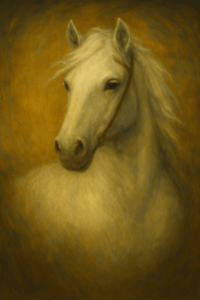
The white horse of Revelation represents divine truth riding out before judgment
Introduction: Beyond Traditional Views
Revelation is often read as God’s judgment unleashed on a rebellious world. But maybe that’s too shallow.
Maybe it’s better understood as the inevitable unraveling that happens when human beings resist the gravitational pull of holiness—a pull that is always relational, always loving, always seeking to restore.
For centuries, Christians have approached the book of Revelation with both fascination and fear. The vivid imagery of the Four Horsemen in chapter 6 has captured our collective imagination, appearing in everything from classical art to modern cinema. But what if our most common interpretations have missed something essential?
The traditional view sees the rider on the white horse as either the Antichrist or as a symbol of conquest and domination. This interpretation has become so embedded in our understanding that we rarely question it. Yet a closer examination of Revelation’s symbolic language suggests something profoundly different.
What if the white horse represents not conquest but proclamation? What if this first seal isn’t about domination but divine disclosure—truth riding out before judgment falls?
And here’s the crux: When we encounter true holiness, we’re invited to surrender to it—not in fear, but in love. To resist that invitation is to fracture ourselves, because what we’re resisting is the very thing that gives us life, purpose, identity, and wholeness.
God’s holiness is not a distant purity—it’s a living pursuit. Before judgment comes, truth rides out.
Let’s begin our journey into Revelation 6 with fresh eyes, seeking not just to understand ancient symbols, but to glimpse the heart of the One who opens the seals.
The Traditional View: White Horse as Conquest
Before we explore an alternative understanding, let’s acknowledge the predominant interpretations of the white horse in Revelation 6:1-2:
“I watched as the Lamb opened the first of the seven seals… I looked, and there before me was a white horse! Its rider held a bow, and he was given a crown, and he rode out as a conqueror bent on conquest.”
The most common interpretations fall into two main categories:
The Antichrist View: Many futurist interpreters see this rider as the Antichrist who comes conquering through deception. This view suggests that white represents a false peace or counterfeit purity—the Antichrist masquerading as a messianic figure.
The Conquest View: Others see this rider more generally as representing military conquest or imperialism—the first in a series of escalating disasters unleashed on the world.
Both interpretations view the white horse negatively, as part of the judgment sequence that brings suffering to humanity. This understanding has shaped how generations of Christians understand the beginning of the tribulation period described in Revelation.
What makes these interpretations compelling is their apparent coherence with the three horsemen that follow—if war, famine, and death represent escalating judgments, it seems logical that the first horse would be negative as well.
The Four Horsemen have traditionally been seen as harbingers of judgment
But this understanding creates several problems:
It requires us to interpret white—a color consistently associated with purity and righteousness throughout Revelation—as representing something false or evil.
It overlooks the significant symbolic differences between the rider in chapter 6 and Jesus in chapter 19.
It neglects the pattern established throughout Scripture, where God’s grace and warning precede judgment.
What if these traditional readings have missed something essential about how God operates? What if the white horse, rather than beginning a sequence of judgments, represents God’s final invitation to truth before consequences unfold?
The Context of Revelation 6: The Lamb’s Actions
As Chapter 6 opens, the atmosphere in heaven shifts dramatically. The Lamb—the only one found worthy to open the scroll—now begins to break its seals. The heavenly worship of Chapter 5 doesn’t fade; it deepens. What was declared in praise is now enacted in history.
But as the scroll begins to open, we must pause to ask: Who is opening these seals? And what does that tell us about what follows?
The answer is critical. The one initiating this next phase of the vision is not a cold agent of divine retribution. He’s not a detached, vengeful deity. The one opening the scroll is the slain Lamb—the one whose worthiness is defined by self-giving love, redemptive suffering, and covenant faithfulness. This reality must govern how we interpret everything that follows.
Because the Lamb is the one opening the seals, the events that unfold aren’t best understood as direct acts of punitive wrath. Rather, they’re the unveiling of covenant consequences—the inevitable results of humanity’s long rejection of the God who made them.
The scroll is not a list of plagues imposed from without, but a record of realities already seeded in the soil of human rebellion. The Lamb isn’t causing chaos; He’s revealing it.
As the seals break, truth is unveiled. This isn’t arbitrary judgment; it’s divine disclosure. The Four Horsemen—symbolizing truth, violence, scarcity, and death—aren’t freshly devised punishments. They’re the logical outcome of a world that has enthroned self in place of God. They’re what happens when covenant is abandoned, when peace is traded for power, and when trust in the Lamb is replaced by trust in empire.
In this light, the Lamb’s action isn’t destructive but revelatory. He doesn’t create the suffering. He exposes it. He brings into the open what humanity tries to hide: the devastating consequences of its own broken allegiances.
The scroll isn’t a threat; it’s a mirror. And the Lamb opens it not to condemn but to confront—to bring truth to light, so redemption can finally begin.
The Significance of White in Biblical Symbolism
To properly interpret the white horse, we must understand how Revelation uses color symbolism, particularly the color white. This isn’t merely a matter of subjective preference—it’s about the internal consistency of John’s symbolic language throughout the book.
The color white consistently symbolizes purity and righteousness in Revelation
In Revelation, white is never ambiguous. It symbolizes purity, victory, and righteousness. Consider these appearances of white throughout the book:
Jesus’ hair is white like wool (Revelation 1:14), symbolizing His purity and divine nature
The faithful in Sardis will walk with Jesus in white (Revelation 3:4-5)
The elders around the throne are clothed in white garments (Revelation 4:4)
The martyrs under the altar are given white robes (Revelation 6:11)
The great multitude stands before the throne in white robes (Revelation 7:9, 13-14)
The armies of heaven follow Jesus on white horses, clothed in white (Revelation 19:14)
Christ Himself rides a white horse when He returns in glory (Revelation 19:11)
Nowhere in Revelation does white represent deception, falsehood, or evil. To make it do so here would break the symbolic consistency of the entire book. If John intended the white horse to represent something false or evil, it would be the only instance in Revelation where white carries such a meaning.
This symbolic consistency matters tremendously for interpretation. If we claim the white horse represents the Antichrist or conquest, we must explain why John would suddenly invert his consistent color symbolism only to return to it later in the book.
For more on biblical color symbolism, see our article on Colors in the Bible: Symbolism, Meaning, and Spiritual Significance.
The Victor’s Crown: Stephanos vs. Diadema
Another key detail is the type of crown worn by the rider. The text says, “a crown was given to him” (Revelation 6:2). The Greek word used here is stephanos (στέφανος), not diadēma (διάδημα).
This distinction is significant:
Stephanos was the victor’s crown—the wreath given to winners in athletic competitions or as honors for civic achievement. It’s the same word used for:
The crown of thorns placed on Jesus’ head (Matthew 27:29)
The crown of life promised to the faithful (Revelation 2:10)
The crowns worn by the 24 elders (Revelation 4:4, 10)
The crown worn by the Son of Man (Revelation 14:14)
Diadēma, in contrast, was the royal crown—the symbol of monarchial authority. This word appears only three times in Revelation:
The dragon has seven diadems (Revelation 12:3)
The beast from the sea has ten diadems (Revelation 13:1)
Christ wears many diadems when He returns as King of kings (Revelation 19:12)
The rider on the white horse wears a stephanos—the crown of the overcomer, not the crown of royal authority. This aligns him symbolically not with the beasts or false rulers, but with the faithful who conquer through Christ.
The stephanos crown was a symbol of victory, not royal authority
These symbolic details point in a consistent direction: the white horse represents something pure and victorious, associated with truth and faithfulness rather than deception or domination.
A Bow Without Arrows: Weapons of Truth
The rider on the white horse holds a bow, but no arrows are mentioned. This detail, often overlooked in interpretations, provides another significant clue to understanding this figure’s identity and purpose.
The image is evocative: it suggests power, but not violence. This is not the sword of domination but the instrument of covenantal declaration. Like the bow of Genesis 9—set in the clouds as a sign of divine restraint—this is a symbol of peace, not bloodshed. The conquest is one of truth, not war.
Throughout Scripture, bows and arrows typically represent judgment or warfare. Yet here, arrows are conspicuously absent. What might this suggest?
A Declaration Without Destruction: The bow without arrows symbolizes a warning that precedes judgment—the power to judge held in reserve while truth is proclaimed.
A Covenant Sign: In Genesis 9:13, God sets His bow in the clouds as a sign of His covenant with Noah. The bow became a symbol of God’s promise and restraint, not His destruction.
The Tension of Truth: A bow drawn but not releasing arrows creates tension—exactly what truth does when it confronts falsehood. It creates the possibility of change before consequences fall.
The nature of this conquest is further clarified by the word used for “conquer” in the text. The Greek word nikaō (νικάω) is used throughout Revelation to describe the faithful who overcome by the blood of the Lamb and the word of their testimony (Revelation 12:11). It’s the same word used in Christ’s promises to the churches:
“To the one who conquers (nikaō), I will grant to eat of the tree of life” (Revelation 2:7)
“The one who conquers (nikaō) will not be hurt by the second death” (Revelation 2:11)
“To the one who conquers (nikaō), I will give some of the hidden manna” (Revelation 2:17)
This word is never used in Revelation to describe the activity of empire or tyranny. The rider on the white horse, then, is not a deceiver. He’s the embodiment of the advance of divine truth, riding out as the first and final witness before judgment unfolds.
Before any consequence is unveiled, truth is proclaimed. The Lamb doesn’t send judgment without first sending the word. This is covenant logic: grace precedes consequence.
The First Seal as Covenant Grace
When we view the white horse through the lens of covenant, we discover a profound theological truth: the first seal is not the beginning of judgment, but the final extension of grace before consequences unfold. This pattern of grace preceding judgment is consistent throughout Scripture.
God’s covenant pattern: grace always precedes judgment
Hesed: God’s Steadfast Love in Action
Central to understanding this pattern is the Hebrew concept of hesed (חֶסֶד)—God’s steadfast, covenant love. Hesed is not merely an emotion; it’s active faithfulness that seeks relationship even when it has been rejected.
The rider on the white horse embodies hesed in action. Before the devastation of the other horsemen is revealed, truth rides out—offering one final opportunity for repentance and return.
This pattern appears repeatedly in Scripture:
Before the flood, Noah preached righteousness for decades (2 Peter 2:5)
Before Sodom’s destruction, Abraham interceded and angels visited (Genesis 18-19)
Before Egypt’s plagues, Moses repeatedly called Pharaoh to “let my people go” (Exodus 5-12)
Before Israel’s exile, prophets warned for generations (Jeremiah 25:4-11)
Before Jerusalem’s fall, Jesus wept over the city that rejected peace (Luke 19:41-44)
God’s nature doesn’t change. His pattern remains consistent: truth precedes consequences. Grace comes before judgment. The opportunity to return precedes the unveiling of rebellion’s results.
For a deeper exploration of God’s covenant love, see our article on Understanding Hesed: God’s Unfailing Love.
Truth Before Consequence: The Divine Pattern
The Lamb opens the first seal not to begin punishment, but to reveal reality. The white horse rides out not to conquer through force, but to conquer through truth—to make one final declaration before the consequences of rejection become fully manifest.
This isn’t the beginning of judgment—it’s the continuation of grace. It’s God saying, “Before you see the results of your choices, let me show you the truth once more.”
The bow without arrows is hesed in visual form—power held in restraint, judgment withheld while truth advances. It’s the offering of light before darkness falls.
This understanding transforms how we read the entire sequence of seals. They aren’t God arbitrarily inflicting suffering on humanity. They’re the progressive unveiling of what is already true—the consequences already seeded in human rebellion, now brought to light by the Lamb’s revelation.
The Four Horsemen: A Progressive Unfolding
When we understand the white horse as the advance of truth rather than conquest, the entire sequence of the Four Horsemen takes on new meaning. They represent not arbitrary punishments, but the progressive unfolding of consequences when truth is rejected.
The White Horse: Truth Proclaimed
“I watched as the Lamb opened the first of the seven seals… I looked, and there before me was a white horse! Its rider held a bow, and he was given a crown, and he rode out as a conqueror bent on conquest.” (Revelation 6:1-2)
The first rider represents the advance of divine truth—the final proclamation before consequences unfold. Like a herald riding ahead of judgment, truth comes first. The rider’s white horse symbolizes purity; his victor’s crown (stephanos) represents the triumph of truth; his bow without arrows signifies declaration without destruction.
This is consistent with Jesus’ words about the end times: “And this gospel of the kingdom will be preached in the whole world as a testimony to all nations, and then the end will come” (Matthew 24:14). Before the end, truth rides out.
The Red Horse: Violence Unleashed
“When the Lamb opened the second seal… Another horse came out, a fiery red one. Its rider was given power to take peace from the earth and to make people kill each other.” (Revelation 6:3-4)
When truth is rejected, peace departs. The red horse represents the violence that emerges when human beings refuse to live by truth. This isn’t God sending violence; it’s God revealing what happens when truth is suppressed. The red horse shows us what we do to each other when we reject the way of peace.
The Black Horse: Scarcity and Inequality
“When the Lamb opened the third seal… I looked, and there before me was a black horse! Its rider was holding a pair of scales in his hand.” (Revelation 6:5-6)
The black horse reveals economic injustice and scarcity. When truth and peace are abandoned, human systems become corrupt, leading to inequality and exploitation. The scales represent not just physical famine but moral imbalance—the unjust distribution that happens when greed replaces compassion.
The Pale Horse: Death’s Dominion
“When the Lamb opened the fourth seal… I looked, and there before me was a pale horse! Its rider was named Death, and Hades was following close behind him.” (Revelation 6:7-8)
The final horseman reveals where violence and injustice ultimately lead—to death itself. The pale horse represents the final consequence of rejecting truth: the culture of death that eventually consumes all who live by the sword, all who build kingdoms on injustice.
When truth is rejected, what follows is not divine vengeance, but the natural unraveling of a world that has refused its Creator’s order.
The Four Horsemen reveal the progressive consequences of rejecting divine truth
Hearing Truth’s Invitation
Revelation’s white horse invites us to reconsider how we understand God’s dealings with humanity. The first seal is not the beginning of wrath, but the final offer of grace—truth riding out before consequences unfold.
This pattern—grace before judgment—is woven throughout Scripture and reflects the very heart of God. He’s not eager to punish; He’s eager to restore. Even in the midst of apocalyptic imagery, we find the fingerprints of divine hesed—steadfast love that seeks relationship even when it has been rejected.
And here’s the crux: This same pattern continues today. Truth still rides out ahead of consequences. God’s holiness still draws us with gravitational force—not to crush us, but to align us with reality, with life as it was meant to be lived.
When we encounter this truth, we face a choice: Will we surrender to it in love, or will we resist it and face the inevitable unraveling that follows?
The rider on the white horse is not a harbinger of doom, but a herald of hope—offering one final opportunity to align with the God who made us, before we face the full consequences of our rebellion.
What will your response be to truth when it rides your way?
What’s your perspective on the white horse in Revelation? Have you encountered this interpretation before? Share your thoughts in the comments below.
This article is the first in a series exploring the four horsemen of Revelation 6.
* * * * * *
? Revelation Reframed — a chapter-by-chapter guide
?️ Theology of the Lamb — a theological deep dive
Author

